Skip to main content
Skip to footer

Felt wall panels

TileFlex

AbstractTile

TileScratch

TileExclusive

SlatTile

SilentDecor

PrintSonic

PrintSlat

PaintSonic
What are felt wall panels?
Felt wall panels are PET felt sheets mounted on the wall that provide sound absorption and reduce reverberation in a room. The porous structure of the felt traps some of the sound waves, rather than reflecting them back into the room like plaster, glass, or concrete.
PET felt contains up to 60% recycled material. Feltdecor panels are available in thicknesses of 9 mm (s.line series, 25 colors) or 12 mm (t.line series, 29 colors). We explain exactly how felt performs sound absorption in the article “Acoustic Felt for Walls: How It Works.”
Which collection should I choose?
| Collection | Appearance | Format | Thickness and Colors |
|---|---|---|---|
| TileFlex | flat tile with milled edges | 600 x 600 mm | 9 mm, 25 colors |
| AbstractTile | triangles, rhombuses, hexagons | Depends on the shape | 9 mm, 25 colors |
| TileScratch | V-cut lines that play with light | 300, 600, or 900 mm | 12 mm, 29 colors |
| TileExclusive | subtle geometric relief | 148 x 444 mm | 12 mm, 29 colors |
| SlatTile | 3D slats | 600 x 2400 mm or custom-sized | 9 or 12 mm |
| SilentDecor | V-cut pattern on a large panel | 1200 x 2400 or 1200 x 2780 mm | 9 or 12 mm |
| PrintSlat | Printing on wooden slats | 600 x 600 mm | 9 mm |
| PrintSonic | Any UV graphic | 600 x 600 mm | 9 mm |
| PaintSonic | painting in a wooden frame | 600 x 600 mm | 9 mm + frame |
A simple rule: tiles (TileFlex, AbstractTile) are arranged into designs and can be easily cut on-site with a utility knife. Large-format tiles (SilentDecor, SlatTile), on the other hand, cover the entire wall with few seams, while printed collections transform the wall into a graphic, logo, or acoustic image. Additionally, you can design your own TileFlex and TileScratch tiles using the FD Studio configurator.
How much of the wall needs to be covered with panels?
A noticeable improvement in acoustics is usually achieved by covering 20 to 30% of the wall surface. Panels work best where sound reflects most strongly—that is, on opposite walls, behind desks, and near conference tables. We discuss placement in more detail in our guide on where best to install acoustic panels.
Where do felt panels work best?
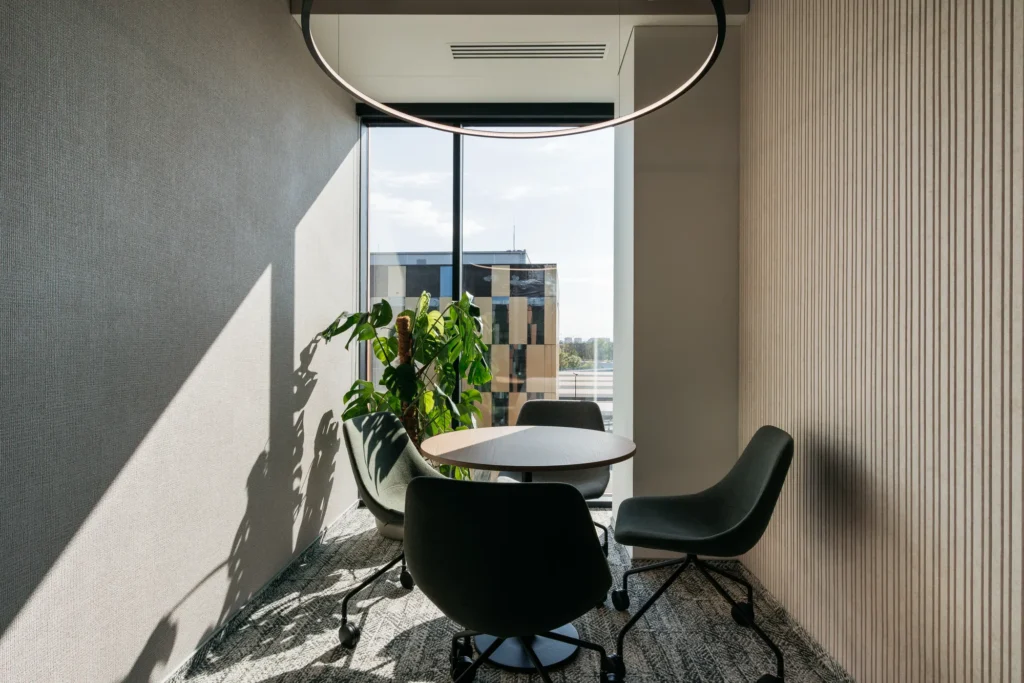
They’re most often found in offices. In open-plan offices, panels behind desks help reduce the overlap of conversations between neighboring workstations. This was the case at the CBRE office in Kraków, where felt covered the walls of the hallways and the areas behind the workstations.
At the Kossak Hotel in Kraków, they reduce reverberation in guest rooms. In conference rooms, they help ensure that conversations and video conferences can be heard clearly, and at home, they work well in a living room with large windows or in a home office.
Would you like to compare acoustic felt with other types of panels? Check out the article on which acoustic wall panels to choose.

Frequently asked questions
What should I use to attach felt panels to the wall?
Most collections are installed using adhesive applied directly to the back of the panel. The wall should be clean, dry, and level, and installation does not require any structural modifications.
Do felt panels soundproof a room?
They perform sound absorption inside the room and reduce reverberation, making conversations clearer and noise less tiring. However, they do not block out sounds coming from behind the wall, such as those from neighbors.
How do you clean felt panels?
Use a vacuum cleaner with a soft attachment; do not scrub.
Can felt panels be cut to size?
Yes. TileFlex and AbstractTile tiles are cut on site with a utility knife, and the panels can also be ordered machine-cut to size.