Skip to main content
Skip to footer

Acoustic ceiling panels: suspended acoustic modules and islands


What are acoustic ceiling panels?
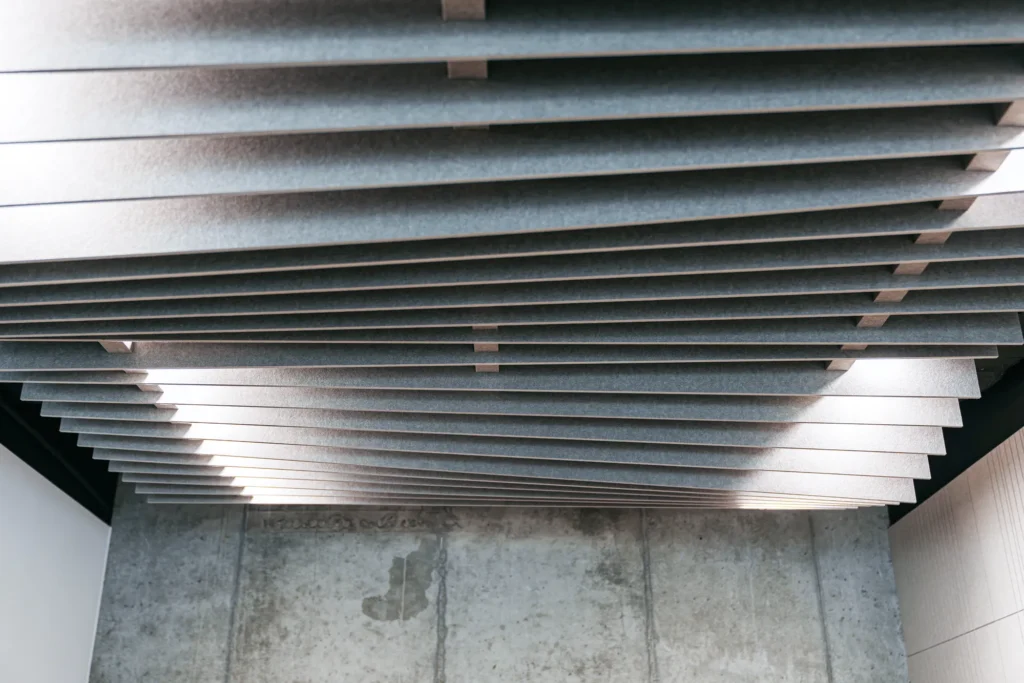
Acoustic ceiling panels are suspended acoustic felt panels that provide sound absorption and reduce reverberation in the room. Feltdecor systems are 9 mm thick and made of PET felt, which contains up to 60% recycled material.
Why the ceiling, specifically? Because it’s usually the largest unobstructed surface in a room. The walls are covered with windows, cabinets, and screens, while the ceiling remains smooth, hard, and empty. In open-plan offices, conference rooms, or restaurants, it accounts for a large portion of the echo. In our article, “Where Is the Best Place to Install Acoustic Panels?”, we explain when it’s better to install them on the ceiling and when on the walls.
Which ceiling system should I choose?
| System | Form | Dimensions | Colors | When to Choose |
|---|---|---|---|---|
| SilentScape | baffles or island | 1200 x 1200 x 210 mm, 2400 x 1200 x 210 mm | 10 | large and high-ceilinged interiors, the ceiling as a design element |
| SilentCloud | flat island | circle, square, rectangle, or custom shape | 25 | zones above desks, tables, and the reception area |
| LinearScape | slats with LED lighting | custom-made | 10 | acoustics and lighting in a single element |
SilentScape consists of vertical slats that can be used to build an entire ceiling or a single island above a selected area; in custom designs, their height, thickness, and spacing can be adjusted. SilentCloud, on the other hand, is a flat panel that is hung exactly where noise is loudest—for example, above a conference table. LinearScape, meanwhile, combines a panel with LED lighting, so a single element hangs above desks instead of a lamp and a panel separately.
Where do suspended acoustic modules work best?
They are most effective in places with high ceilings and plenty of glass, concrete, and smooth walls: in offices and open-plan offices, conference rooms, and hotels and lobbies.
At Tauron’s headquarters in Wrocław, felt ceilings and islands have reduced reverberation in the office space. In the StoryMakers podcast studio in Kraków, the slats on the ceiling work in tandem with the panels on the walls. And in our article about the office at AGH University of Science and Technology, we show how these modules transformed the office there.

How do you install acoustic panels on the ceiling?
The modules are suspended from steel cables, and SilentScape can also be screwed to the ceiling using profiles. All mounting accessories are included in the kit, so there’s no need to build a separate structure to support them. You can find more information about selection and installation in the guide to lightweight acoustic ceiling panels.
Frequently asked questions
Which works better: ceiling panels or wall panels?
It depends on the room. In rooms with high ceilings and open-plan offices, the ceiling provides the largest surface area for sound absorption. In rooms with parallel walls, wall panels eliminate the echo that bounces between them. In many spaces, combining both methods yields the best results.
Which acoustic ceiling panels should I choose?
For large and high-ceilinged spaces, SilentScape slats work best, as they create a baffle-type ceiling. Above a specific area, such as a conference table or reception desk, it’s better to hang flat SilentCloud islands. If lighting is also needed above workstations, LinearScape combines an acoustic panel with LED lighting.
Will ceiling panels block out noise from other rooms?
No. They have sound absorption properties inside the room and reduce reverberation, but they do not block noise coming from behind the wall or ceiling.
Can I order a different shape, size, or color?
Yes. SilentCloud is custom-made, and with SilentScape, you can adjust the height and spacing of the slats. Colors outside the standard palette have a lead time of 8 to 12 weeks.