Skip to main content
Skip to footer

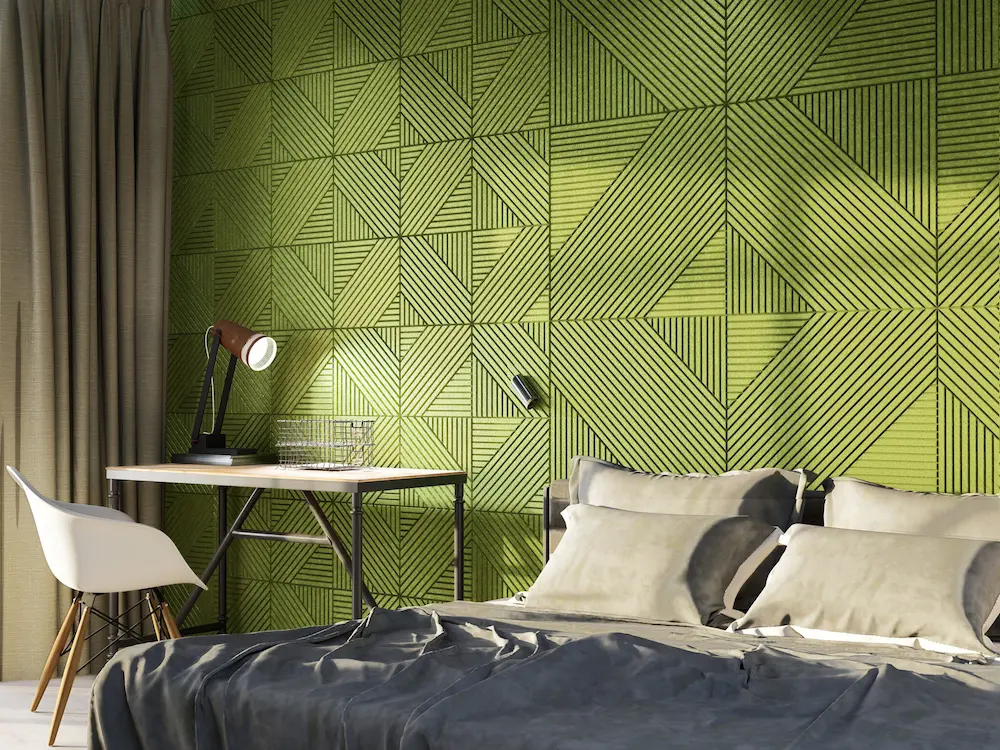
What is acoustic felt?
Acoustic felt is a material with a dense, fibrous structure that absorbs sound waves and reduces reverberation indoors. It makes conversations clearer, reduces noise fatigue, and creates a calmer environment.
Have you ever been to a restaurant where you had to raise your voice so the waiter could hear you? Or to an office where a coworker’s phone call became background noise for the entire floor? These are examples of poor acoustics. This invisible problem can be more tiring than poorly positioned lighting or an uncomfortable chair.
That’s the magic of acoustic felt. But what exactly is acoustic felt, and why is it so effective at reducing noise?
For many people, the word “felt” sounds familiar—it brings to mind a hat, a laptop sleeve, or a coaster. However, acoustic felt is a whole different story. It’s a material that not only adds style but actually changes the way you perceive a space.
The easiest way to visualize this is with a simple example. Sounds in a room behave like ping-pong balls—they bounce off the walls and ceiling, return, and overlap, creating reverberation. When felt panels come into play, the “balls” hit the dense, fibrous structure of the material and, instead of bouncing endlessly, are absorbed.
The secret is in the technology. PET felt is made from recycled plastic bottles, and its fibers form a kind of “trap network.” Each fiber traps a sound wave and dissipates its energy within its structure, so noise is effectively dampened.
Made from recycled plastic bottles. PET fibers form a dense, porous structure that traps sound waves and dissipates their energy, rather than allowing them to bounce off.
How does it work in practice?
A paneled ceiling absorbs sound waves that would normally bounce back from the ceiling and create an echo. The side walls no longer act as mirrors. Panels mounted at a distance from the wall also absorb lower frequencies, such as the thud of footsteps in the hallway or bass from a home theater system.
The effect can be heard immediately:
- In the office, phones stop disturbing people at neighboring desks,
- In the conference room, every sentence is clear, without raising the voice,
- At home, the movie sounds like a theater, and the volume remote can finally rest,
- In a museum or art gallery, silence becomes a natural background to focus on the exhibits.
So you could say that acoustic felt organizes sound. It turns chaos into harmony, and reverberation into a pleasant, quiet space.
Read more in our article “Acoustic Felt Panels—What You Should Know Before Buying.”
If a room has mostly hard, high surfaces, start with the ceiling, because that’s where most of the sound bounces back from. In smaller, more intimate spaces, wall panels work better.
Does felt reduce noise in a room?
Acoustic felt provides sound absorption, which means it reduces reverberation and echoes indoors. However, it is not an insulating material: it will not block noise coming through the wall from an adjacent room. It works best in spaces where excessive noise and reverberation are a problem, such as in an office, restaurant, or living room.
Acoustic felt on walls and ceilings: where it works best
Acoustic felt is most often mounted on walls, because walls reflect sound like a mirror and contribute most to reverberation. PET felt panels on the wall absorb these reflections, and when hung with a small gap, they also handle lower frequencies, such as rumbling from the hallway. Acoustic felt on the ceiling, in turn, captures sound waves bouncing back from above, which create echoes. As a result, acoustic felt on walls and ceilings works well wherever quiet is essential: in the living room, bedroom, open-plan office, or conference room. Adhesive installation is simple enough that it doesn’t require any additional framing. We’ve described exactly how to arrange the panels in a specific interior in a separate article on installing acoustic panels.
Applications of acoustic felt
Felt acoustic panels are a solution that you can use in many types of spaces. They are most commonly found in:
- living room and home theater – improve the reception of movies and music,
- Children’s room – they dampen play and noise,
- bedrooms – increase sleeping comfort and privacy,
- open-plan office— they reduce noise from conversations and phone calls,
- Conference rooms, schools, lecture halls – improve speech intelligibility,
- Restaurants and hotels – they eliminate reverberation and build a pleasant atmosphere.

Ecology and safety – arguments that make a difference
Today’s architecture does not stop with aesthetics. Increasingly, customers are asking about the environmental impact of materials and the safety of users. Acoustic felt made of PET is an example of a solution that meets these requirements 100%.
Ecology – the second life of PET bottles
Every Feltdecor panel is made from recycled plastic. This means that bottles that would normally end up in a landfill are transformed into attractive and functional interior design elements. In commercial and competitive bidding projects, this is a huge advantage—you can clearly tell the client: “This product isn’t just about design; it’s also a real contribution to the circular economy.”
Safety and health
PET felt is hypoallergenic and safe for everyday use – it does not dust, does not emit toxic substances, and does not irritate the skin or respiratory system. This is important both in office spaces and in schools and kindergartens.
Fire resistance – a requirement of public spaces
Feltdecor panels have a fire rating of B-s1,d0 (a material that is difficult to ignite, with very limited smoke emission and no burning droplets).
In practice, this means that in the event of a fire, the panels do not spread fire and emit minimal smoke, making them safe for use in public spaces. For an architect, this is a ready argument in a conversation with an investor – a safe and compliant product, approved for public spaces. Which can be used without fear in offices, hotels, restaurants or public facilities.
Durability – an investment for years
Unlike acoustic foam, which yellows and crumbles after a few years, PET felt retains its appearance and properties for over 10–15 years. It does not require frequent replacement or costly maintenance. This means that the project not only looks good upon completion but also maintains its quality for a long time.
That is why acoustic felt is not just a passing trend, but a material that addresses the real challenges of contemporary architecture.
PET felt vs. other materials: Which one should you choose?
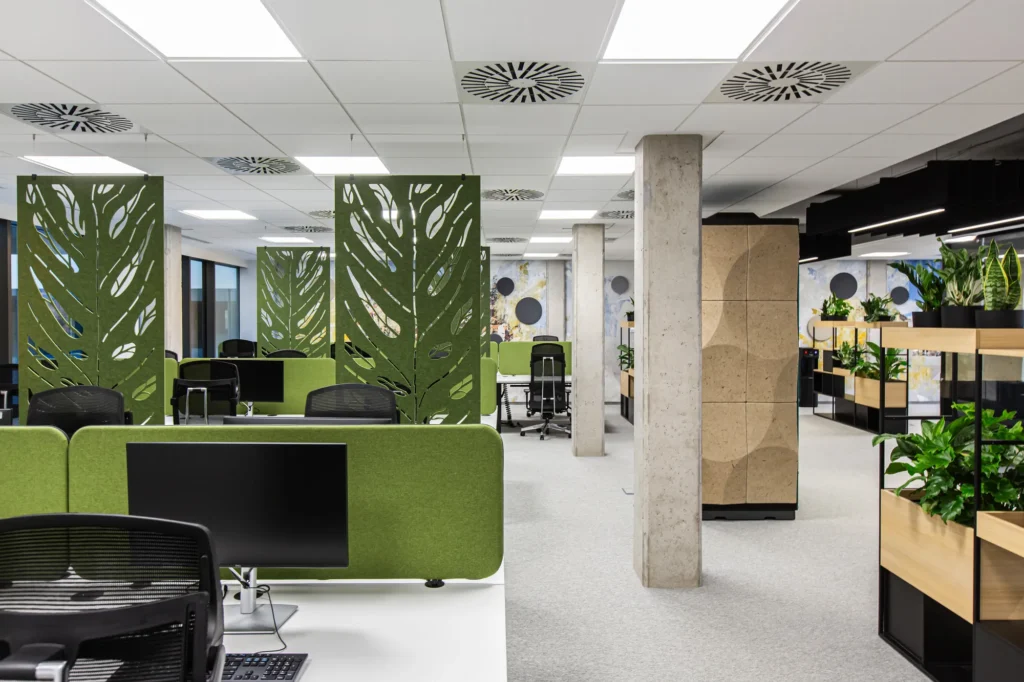
There are several popular acoustic solutions on the market. That’s why customers often ask us, “Why should I choose PET felt when there are cheaper options?” Here’s a brief, practical comparison to help you make your choice:
Acoustic foam
Foam is the cheapest and simplest solution. Lightweight, readily available, it is often found in recording studios or garages converted into rehearsal rooms. The problem is that it ages quickly: it turns yellow, crumbles, and on top of that it doesn’t meet fire safety standards. The acoustic effect is there, but the aesthetics and durability are rather lacking.
PET felt
And that’s where PET felt comes in—a material that combines technology, aesthetics, and durability. At first glance, it looks like an elegant wall covering, but its properties go far beyond mere decoration. PET felt is made from recycled plastic bottles, making it a solution to today’s environmental challenges.
It is safe (fire class B-s1,d0), color stable and easy to maintain – it will not dust, fade or yellow over time. A simple vacuum cleaner or a damp cloth is enough to restore its perfect appearance.
Although its initial price is higher than that of acoustic foam, its durability of more than 10-15 years makes it a far more cost-effective solution in the long run.
PET felt or wool felt?
Acoustic felt comes in two main varieties. Wool felt is made from natural fibers, while PET felt is made from polyester fibers; in the case of Feltdecor, recycled materials are used. Both have sound absorption properties, but they differ in appearance, maintenance, and color options.
| PET felt | Wool felt | |
|---|---|---|
| Raw material | PET fibers, recycled | natural fibers, wool |
| Cleaning | vacuum cleaner, damp cloth | requires greater caution |
| Look | colorfast, wide range of colors | natural texture |
| Application | offices, restaurants, hotels, homes | interiors that feature natural materials |
Why should you choose Feltdecor acoustic felt?
Acoustic felt is a material that combines functionality with design. Architects and designers value it not only for its effectiveness in reducing noise, but also for the fact that it fits naturally into a variety of interior styles – from minimalist offices to modern restaurants.
An informed choice
Feltdecor panels are made from recycled PET. This means that by improving acoustics, you’re supporting sustainable design and reducing the amount of waste sent to landfills.
Aesthetics and form
These aren’t technical mats that need to be hidden. Panels from the TileFlex and TileScratch collections create geometric compositions, decorative textures, and an interesting interplay of light and shadow. As a result, acoustics become part of the interior’s aesthetics, rather than just a hidden technical element.
Comfort and safety
The PET felt used in the panels has a fire rating of B-s1,d0 (a flame-resistant material with minimal smoke emission and no burning droplets). In practice, this means that the panels are safe to use—whether in offices, hotels, or public spaces.
Durability and everyday comfort
PET felt does not lose color, does not deform and retains its acoustic properties for many years.
It requires no maintenance or replacement, and literally takes a moment to clean. It’s a solution that maintains the quality of your project over time, without additional cost or labor.
PET felt is an investment in comfort, aesthetics and durability.
It works well wherever quiet, style and longevity are important – from home living rooms to modern offices.
Types of PET felt panels.
Acoustic panels made of PET felt are not technical contraptions that need to be hidden somewhere, but full-fledged elements of interior design. Thanks to their aesthetics and form, they can become a subtle background of an arrangement or its distinctive accent.
In the hands of an architect and designer, they gain a whole new dimension – they allow to combine acoustic function with aesthetics, creating spaces that are both beautiful and pleasing to look at.
Each Feltdecor collection has its own unique character and different applications. Choosing the right model depends on the effect you want to achieve in your design—whether you’re looking for minimalist geometry, a decorative texture, or a solution that will blend discreetly into the background.
TileFlex – Geometry and Ease of Installation

TileFlex consists of 600 × 600 mm square modules that can be arranged in various patterns. Thanks to its adhesive installation, setup is quick and requires no additional framing. This solution will be particularly appreciated by designers working in offices that need a quick and aesthetically pleasing improvement in acoustics, in conference rooms where speech intelligibility is crucial, as well as in homes—behind the TV, in the bedroom, or in the children’s room.
SilentScape – Silence Under the Ceiling
SilentScape is a system of suspended islands and baffles. Mounted on the ceiling—where sound waves reflect most intensely—they act as an acoustic shield. In open-plan offices, they reduce the noise from conversations and phone calls; in restaurants, they create a peaceful atmosphere; and in hotel lobbies or performance spaces, they help manage the challenging acoustics of large, high-ceilinged spaces.
TileScratch – Acoustics Meets Art
TileScratch is a collection designed for those who expect more from panels than just acoustic performance. It combines technology with artistic design—the panels not only provide sound absorption but also decorate the space in a unique way.
Delicate, linocut-inspired patterns create a subtle sense of depth, while the interplay of light and shadow gives the wall a sculptural quality.
It’s the perfect choice for hotel lobbies, elegant restaurants, or meeting rooms, where atmosphere, aesthetics, and first impressions matter most.

PET felt is a material that allows you to design interiors that are beautiful and functional at the same time. It is a way to make the design work not only visually, but also acoustically. It is ecological, safe and durable, while giving the architect freedom of choice – from simple modules to artistic panels. With it, reverberation ceases to be a problem and the design really starts to work: less noise, more peace and comfort.
If you want to learn more and see specific examples of acoustic felt applications in various interiors, read our article: “Where is the best place to install acoustic panels?“.