Skip to main content
Skip to footer

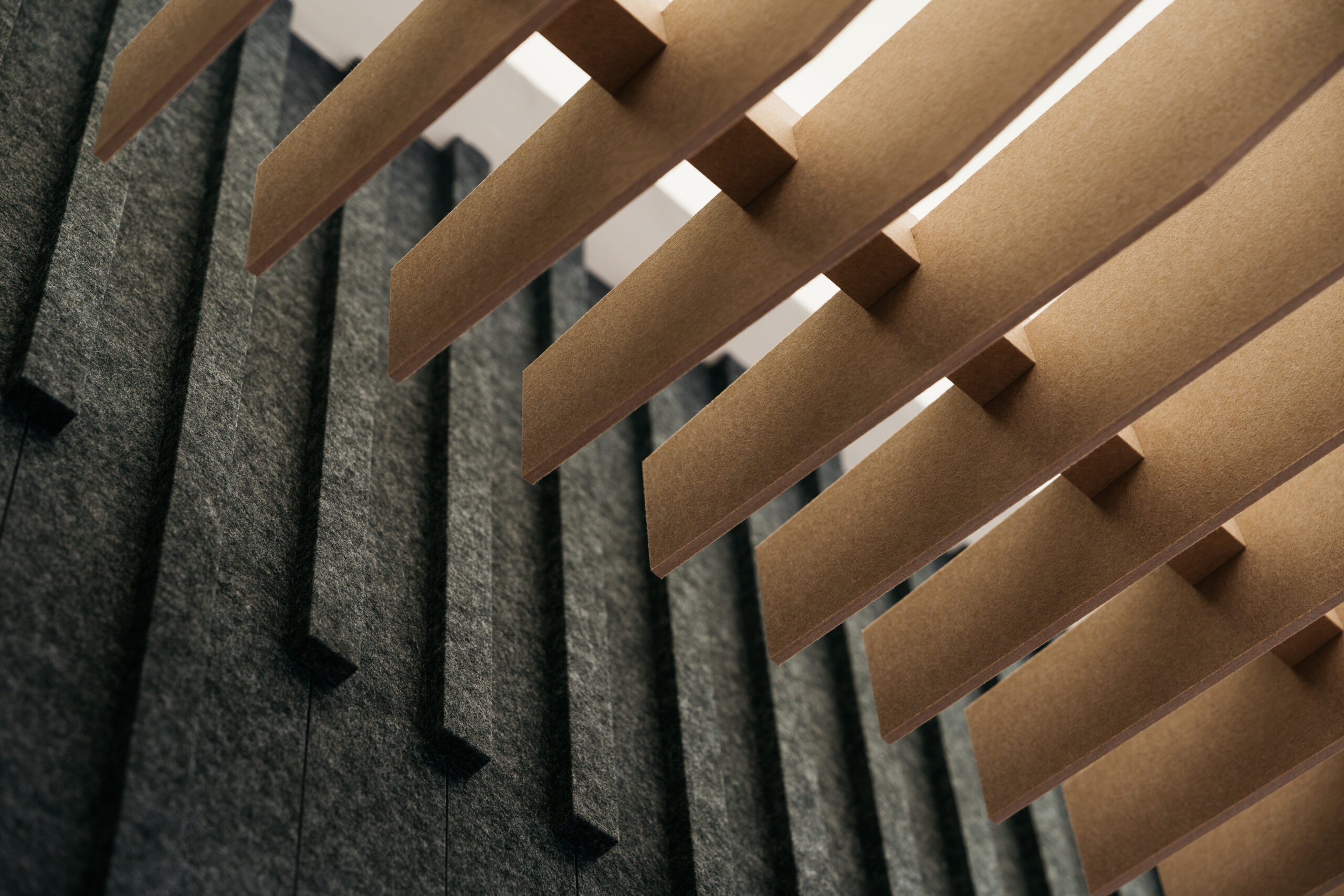
Large volumes, hard floors, glass walls, and furniture with smooth finishes—this is a classic recipe for reverberation problems in commercial and educational spaces. When noise and annoying echoes make it impossible to have a normal phone conversation or work with concentration, traditional acoustic treatment is often associated with a multi-day renovation, dust, and having to close the office for several days.
Does improving acoustics in an operational facility require costly downtime? A projectfor the AGH University of Science and Technology in Kraków provesthat advanced materials engineering based on PET felt (rPET), combined with prefabricated suspended acoustic modules, can solve this problemin just one day—quickly, cleanly, and without having to close the office for several days.
Challenge: A traditional office with a problem of increasing echo
The office space at the university featured a typical material configuration that created challenging acoustic conditions:
- The hard floor and lack of soft finishes: the sound bounced off the flat surfaces repeatedly without any sound-absorbing barriers.
- It was not possible to make significant changes to the walls:the vertical surfaces were occupied by built-in furniture and hallways.
- The need to maintain business continuity: this ruled out traditional, wet construction work, drilling a large number of holes, or erecting heavy substructures.
The sound echoing throughout the room caused users to tire quickly and made it difficult for them to concentrate. The solution was to use the ceiling as the main sound-absorbing surface.
SilentScape Suspended Acoustic Module System
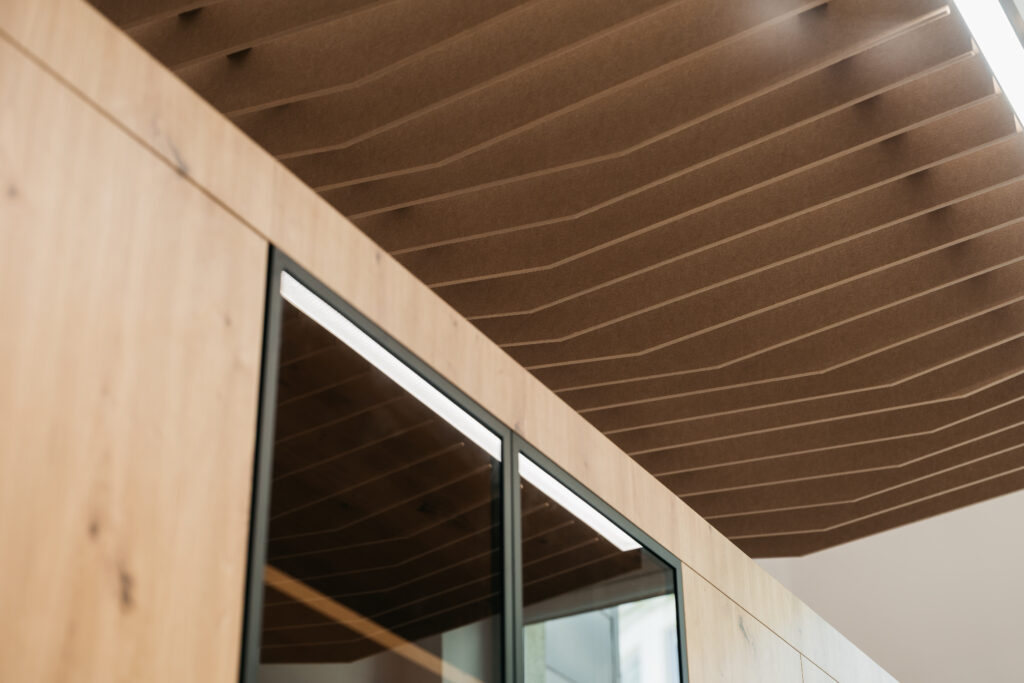
The design features suspended islands and suspended acoustic modules fromthe SilentScape collection, made of dense PET polyester nonwoven fabric.
Why did the ceiling turn out to be a key surface?
- Maximizing the absorbent surface area:the ceiling was the only available surface with such a large area.
- Bidirectional response to reflected sound waves:suspended islands capture sound from two directions (from below and from the ceiling), limiting the spread of noise between workstations.
- Non-invasive and dust-free installation:The use of lightweight cable slings made it possible to install the system without having to protect the floor or furniture, without creating dust, and without disrupting office operations.
Designer – contribution to the project and working with PET felt
We talk withdesigner Wojtek Mazur—who was responsible for the spatial concept of this renovation—about the behind-the-scenes process of preparing the project, creating a custom layout, and the flexibility of solutions that combine catalog items with original design.
What were the characteristics of this space before the changes were made, and where did the noise problem come from?
It was a textbook example of an interior that lacked any sound-absorbing elements. Hard floors, smooth countertops, no soft fabrics. All you had to do was walk in and say a few words to feel the annoying reverberation. Even a simple phone conversation created overlapping echoes, and after a few hours, working in such conditions simply became exhausting.
How did the design process go, and what was your role in planning this space?
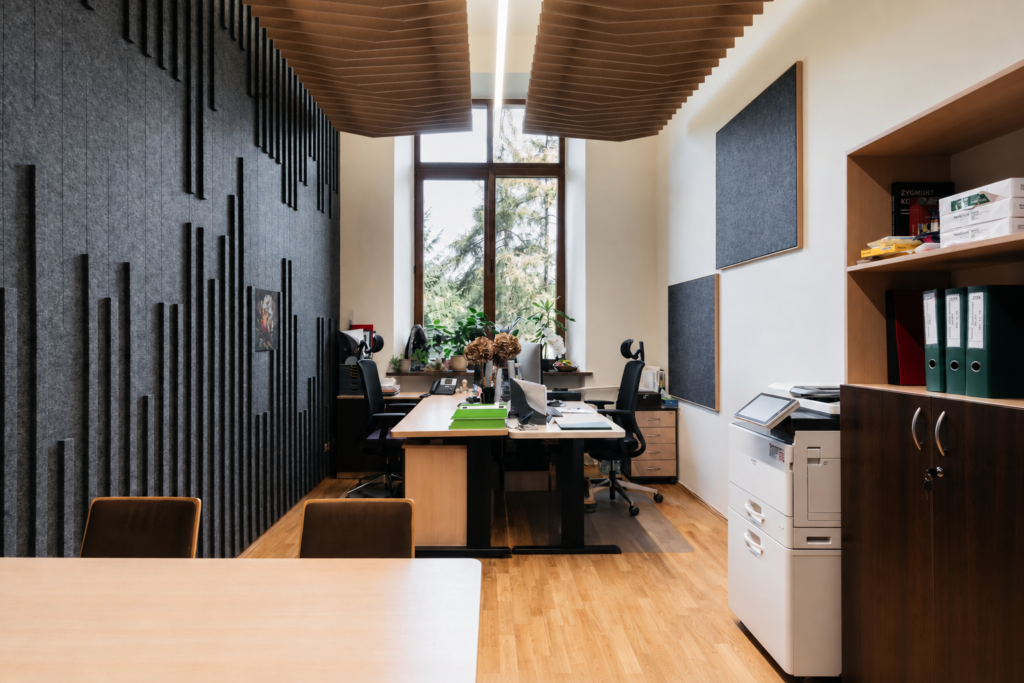
The main task was to design this system so that it would work perfectly with the room’s geometry and existing lighting. The ready-made 3D files and three-dimensional models of the SilentScape modules proved to be extremely helpful. All we had to do was analyze the room’s layout, ceiling height, and the routing of the wiring, and then assemble the dedicated modules into larger ceiling clusters.
Designing in a 3D environment gave us complete control over scale, rhythm, and proportions. We were able to precisely verify that there were no collisions with the lights and eliminate any risks before the crew even arrived on site.
In this project, you combined ceiling modules with accents on the wall. What led to that decision?
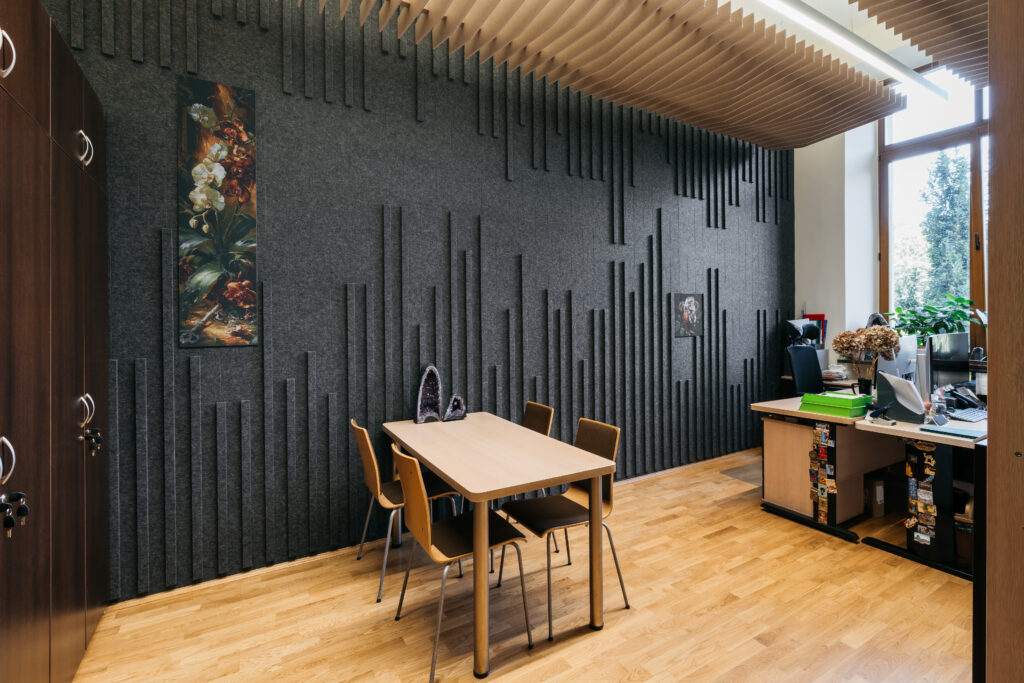
The ceiling did the technical work—it took on the bulk of the task of dampening echoes and reducing reverberation time. However, I didn’t want the entire design to rely solely on repetitive, off-the-shelf forms. That’s why a bold, unique accent was added to the wall.
I designed a custom layout of felt slats and acoustic slat panels with custom prints specifically for this interior. This combination of off-the-shelf solutions from the catalog and a custom, made-to-measure design achieved the best possible balance: we maintained a very high sound absorption coefficient, and the interior gained a unique visual identity.
What advice would you give to designers facing a similar challenge in existing offices?
First and foremost—plan the acoustics in advance. However, if you’re improving a space that’s already in use and need a quick solution, suspended acoustic modules are the safest option. They don’t require complex substructures, don’t create a mess or generate dust during installation, and provide an immediate effect as soon as they’re hung.
The Final Result and an Anecdote from the Handover
The best proof of the effectiveness of the acoustic treatment was not just the technical measurements, but the spontaneous reaction of people who had known this office for years.
Immediately after the installation work was completed, an unusual situation arose—workers entering the room in the morning would, out of habit, start speaking in raised voices, expecting the familiar, annoying echo. However, they stopped mid-sentence, surprised by the deep, comforting silence. The difference in how the space was perceived was so striking that many people asked in disbelief what had happened here and joked that, acoustically speaking, they had ended up in a completely different building.
Why should you choose PET ceiling modules?
- Installation in 1 day:dust-free installation with no need to shut down the office, cover furniture, or damage the floors.
- Safety and Certification:PET nonwoven fabric has a flame-retardant rating of B-s1, d0 (required in public and commercial facilities).
- Design flexibility: Easily combine ready-made components from the SilentScape catalog with custom wall slats.
- Guaranteed results:an immediate reduction in reverberation time and improved comfort in your daily work.
BREEAM/LEED Certification and the Real Value of PET in Modern Specifications
The use of PET felt not only provides an immediate improvement in acoustic comfort but also serves as a strong selling point for the certification of commercial and public buildings. Materials made from recycled rPET polymer perfectly align with green building requirements and the circular economy concept (Design for Disassembly). By choosing certified modules with a B-s1, d0 rating, interior designers receive a product that easily passes all technical and fire safety inspections, while simultaneously improving the facility’s score in environmental criteria and indoor environmental quality.
Make a quiet interior the standard for your projects
The project at the AGH University of Science and Technology in Kraków demonstrates that acoustic challenges in public buildings do not have to mean compromising on aesthetics or causing days-long office downtime. A well-thought-out concept—combining ready-made suspended acoustic modules from the catalog with a custom wall installation—makes it possible to transform a noisy office into a space ideal for concentration in just one day.
PET felt is no longer just an eco-friendly alternative material. Today, it is a fully-fledged, advanced tool in the hands of interior designers, combining acoustic engineering, durability, and precision craftsmanship.
Would you like to explore the full potential of recycled materials in architecture?
The AGH case study is just one example of PET’s practical applications. If you’d like to see a complete list of materials, physical properties, fire safety standards, and detailed specification guidelines for designers and architects, check out our flagship guide:
👉Read our article: Acoustic felt—how does it work, and why should you have it in your home?