Skip to main content
Skip to footer
Skip to main content
Skip to footer

How to improve interior acoustics without giving up natural motifs and design?
There are moments when a material stops being just a medium and starts becoming a tool for thinking. Not a finished product, nor a catalogue sample. Just a starting point for observation, experimentation, and the first design decisions. This is exactly why meetings with students are so important to us. They allow us to see felt not merely as an interior element, but as a medium through which form is born.
During our visit to the Academy of Fine Arts in Katowice, we had the opportunity to meet first-year industrial design students who were working on an assignment based on analyzing nature and translating its structures into spatial objects. The theme centered around forms inspired by botany – leaves, stems, rhythms, divisions, layering, as well as how natural arrangements can be simplified, processed, and transformed into a real proposal for an interior. The end result consisted not only of formal exercises, but the first prototypes of thinking about panels, dividers, lamps, or ceiling elements.
This is precisely the most interesting stage. A moment when a project is not yet a “finished design”, but is starting to take direction. The students first observed nature, analyzed the structure of selected plants, and looked for their structural logic, later translating these observations into simplified, spatial arrangements. Felt proved to be a very natural material here – lightweight, easy to cut, allowing for quick testing of form, density, light, and the relationship of elements in space.
From our perspective, such a meeting holds a double value. On one hand, it shows how young designers build their own formal language and how they seek a relationship between material and function. On the other – it serves as a reminder that felt does not have to be treated from the very beginning solely as a finished acoustic panel or a decorative cladding. It can be a material for prototyping, for learning how to think in terms of modules, structure, and repeatability. And that was precisely the most interesting part of this collaboration: observing how the first spatial interpretations, inspired by plant life, emerge with the potential to become real interior solutions.
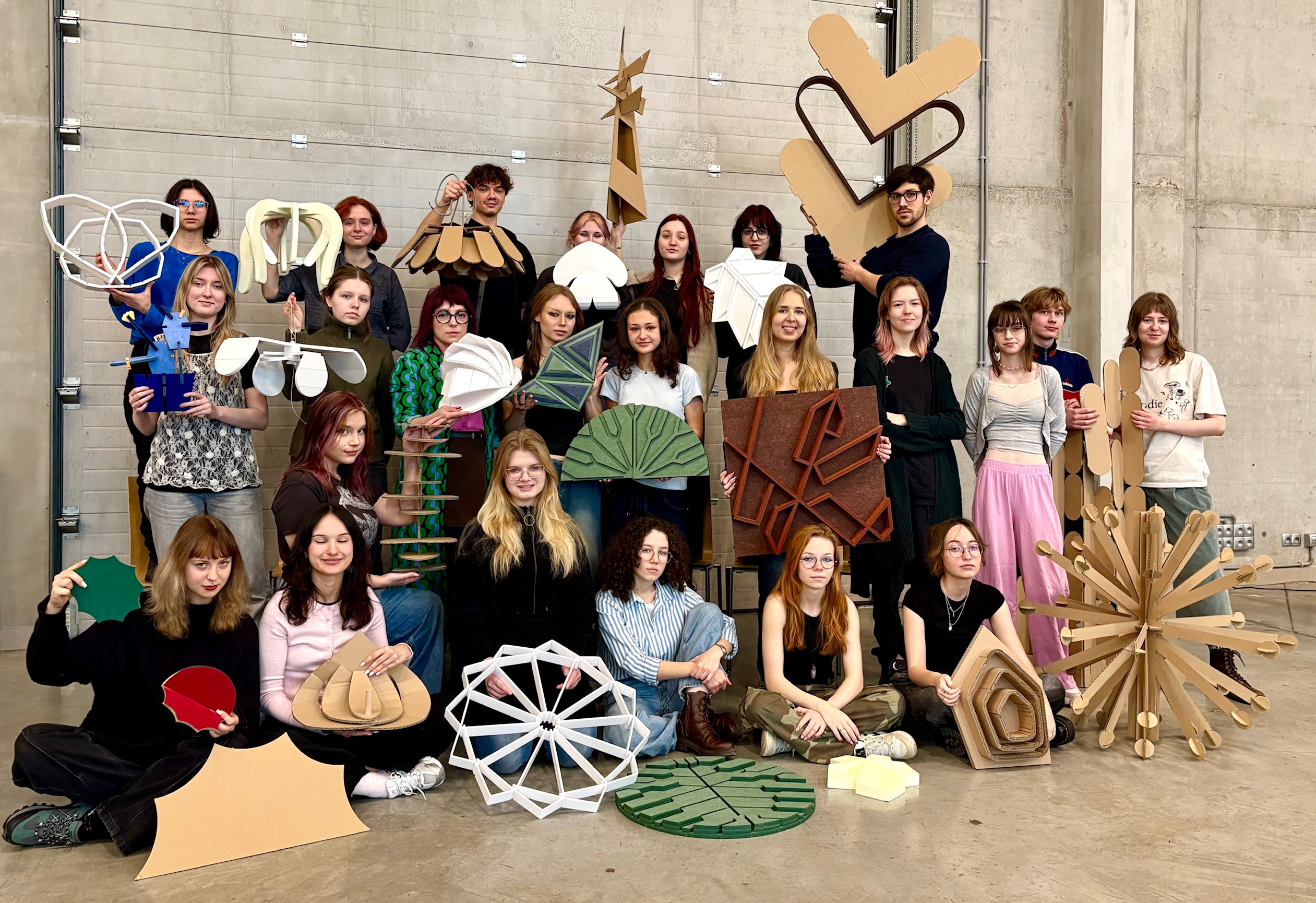
From the observation of nature to spatial form
The entire process did not start with a ready-made idea for a panel or a lamp. It started with looking. The students went to the palm house in Gliwice, selected specific plants, and began to analyze them through sketching: their types, divisions, leaf arrangements, growth patterns, and the relationships between elements. This was a very important stage because it wasn’t about drawing a pretty leaf, but about understanding how a given form works and what actually builds it.
Then came the second phase: simplification. The natural form was broken down into simpler, repeatable elements. Students looked for what was most crucial in it: module, direction, tension, rhythm. Instead of literally copying nature, they began to translate it into a design language. And this is where it gets really interesting, because this is the moment when observation turns into a decision. What to keep? What to simplify? What to repeat? What to scale up?
The next step involved working models and interpretations of the structure of selected natural objects. This was no longer just work on paper. The form began to enter three-dimensional space. The first attempts at building layered arrangements, openwork structures, and modules emerged, which could be combined with one another and tested for light, shadow, and the relationship between solid and void. Only at this stage did felt begin to function as a real prototyping material. Combined with cardboard, it allowed for quick verification of whether a given concept possessed spatial potential and whether it could be developed further as an interior element.
Ultimately, spatial forms made of cardboard and felt were created, along with proposals for their interior application: as a panel, ceiling, screen, lamp, or another functional element. This is important because the exercise did not end with the form itself. From the beginning, the goal was to check how such an object could function in a real context, how it affects space, and what role it can play. As a result, the students did not work solely on aesthetics, but on the full design process: from analysis, through synthesis, to the first answer to the question of where and why such an object should appear.
From our perspective, this is the most fascinating part of such assignments. You are watching the moment where design truly begins. Forms inspired by botany are not a decorative quote from nature here, but an attempt to understand how to build something out of natural logic that can later function in interior architecture. And that is precisely why felt fit so well into this exercise – it didn’t impose answers; it allowed them to be tested.
Felt as a material for experimenting
with thinking. At the stage of the first prototypes, students needed a medium that would allow them to quickly check whether a form made sense in space, and whether it worked well with layering, light, rhythm, and scale. Felt fit this need very naturally because it is lightweight, flexible, easy to cut, and at the same time stable enough to allow for the construction of more complex arrangements.
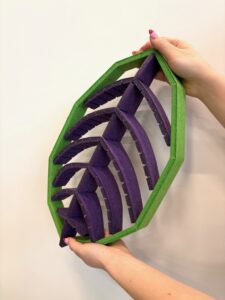 It was precisely thanks to such properties that it was possible to transition quite quickly from observation and sketching to a physical object. There was no need to wait for complex processing or heavy technology. Basic operations were enough: cutting, folding, layering, and testing divisions. This is highly important at the stage of learning design, because the material should not hold back an idea at that point. It should help verify it.
Felt also beautifully demonstrates something that is incredibly vital in interior design: the relationship between plane and space. On the surface, you have a simple, flat sheet. But once you start cutting, folding, layering, or adding rhythm to it, depth appears immediately. Light and shadow emerge. A soft boundary between surface and form is created. And this was clearly visible in the botany-inspired prototypes – even simple modules began to build highly expressive, spatial systems.
From our perspective, this was particularly interesting also because it is exactly how felt works later in real interiors. As a wall panel, a ceiling element, a divider, or a decorative detail, it very often does not work through color or contour alone. It works through layering. Density. Shadow. Repeatability. The student models already showcased these same mechanisms, just in a pure, experimental form. For us, it provided a fresh look at our product.
Felt also proved to be a material that responds well to interpretations of nature. It is visually soft, yet it can be structured. It allows for the construction of both organic and more geometric forms. It can be cut precisely or treated more intuitively. Thanks to this, students did not have to choose between freedom and control. They could test different paths. And that is highly valuable in the first stage of design education.
What does such collaboration bring to the students and to us?
From the students’ perspective, this is something more than a one-time material exercise. It is a contact with a medium that functions not only in the classroom, but also in real interior design projects. Thanks to this, felt stops being an abstract material from a sample book and starts to become something that can be immediately embedded in a specific context: a panel, a divider, a lamp, a ceiling. Such a moment is important because it teaches thinking not only through form, but also through application.
It is also an excellent exercise in design responsibility. The students did not end their work with a striking model. They had to answer the question of where a given object would function, what purpose it would serve, and how it would behave in an interior. Would it be a background or a dominant feature? Would it structure the space or divide it? Would it work with light, rhythm, or perhaps give the user a sense of shelter? It is precisely these questions that build a solid foundation for further design work.
For us, such a meeting also holds great value. On one hand, we can showcase the material beyond the catalog and the finished product. On the other – we get to see how people who are not yet tied to established patterns react to it. Students look at it with fresh eyes. They often see potential in the material that can easily be missed in daily design work. They don’t start with the question of what product to make out of it. They start with the question of what can be extracted from this material.
It is precisely in situations like these that we see how crucial collaboration between education and practice is. The university provides a space for experimentation, testing, and making mistakes. The brand provides the material, knowledge of its properties, and a broader context of application. When these two worlds meet, something far more interesting than a standard product presentation is born. A process is established in which one can truly witness how a project comes to life..
For us, it is also a reminder that the material does not end with its functional purpose. Felt can be acoustic, decorative, modular, and easy to install, but before it becomes all of that, it is first a medium that triggers thinking. And that was the most valuable part of this collaboration: the opportunity to see how the first conscious design decisions begin to grow from simple observations and experimentation.
This visit was important to us not because we could showcase the material. The most fascinating part was getting to see what happens to it when it falls into the hands of people who are just building their own way of thinking about design. Free from ready-made patterns. Without being tied to a single solution. With great mindfulness toward form, rhythm, and the relationship between nature and space.
The botany-inspired student prototypes showed that even a simple material can trigger vastly different directions of thought. Some moved toward lightweight and openwork structures, while others built more compact, layered, almost architectural forms. In each of these approaches, one could see what is most valuable in design: an attempt to translate observation into a conscious spatial decision.
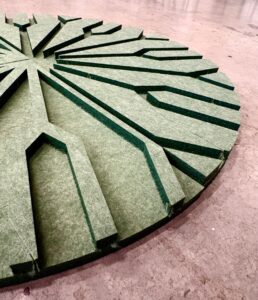 From our perspective, this is also a reminder that felt does not have to be understood solely as a finished panel or an end product. It can be a material that helps explore, test, and build the first ideas. That is why such meetings are so necessary. They connect education with practice. They show that the distance between analyzing nature and creating a real interior object is not as vast as it might seem.
We would like to thank the Academy of Fine Arts in Katowice for the invitation and the opportunity to participate in this process. We look forward with curiosity to seeing how these initial experiments continue to evolve and how subsequent, increasingly mature forms develop from simple botanical inspirations.