Skip to main content
Skip to footer
Skip to main content
Skip to footer

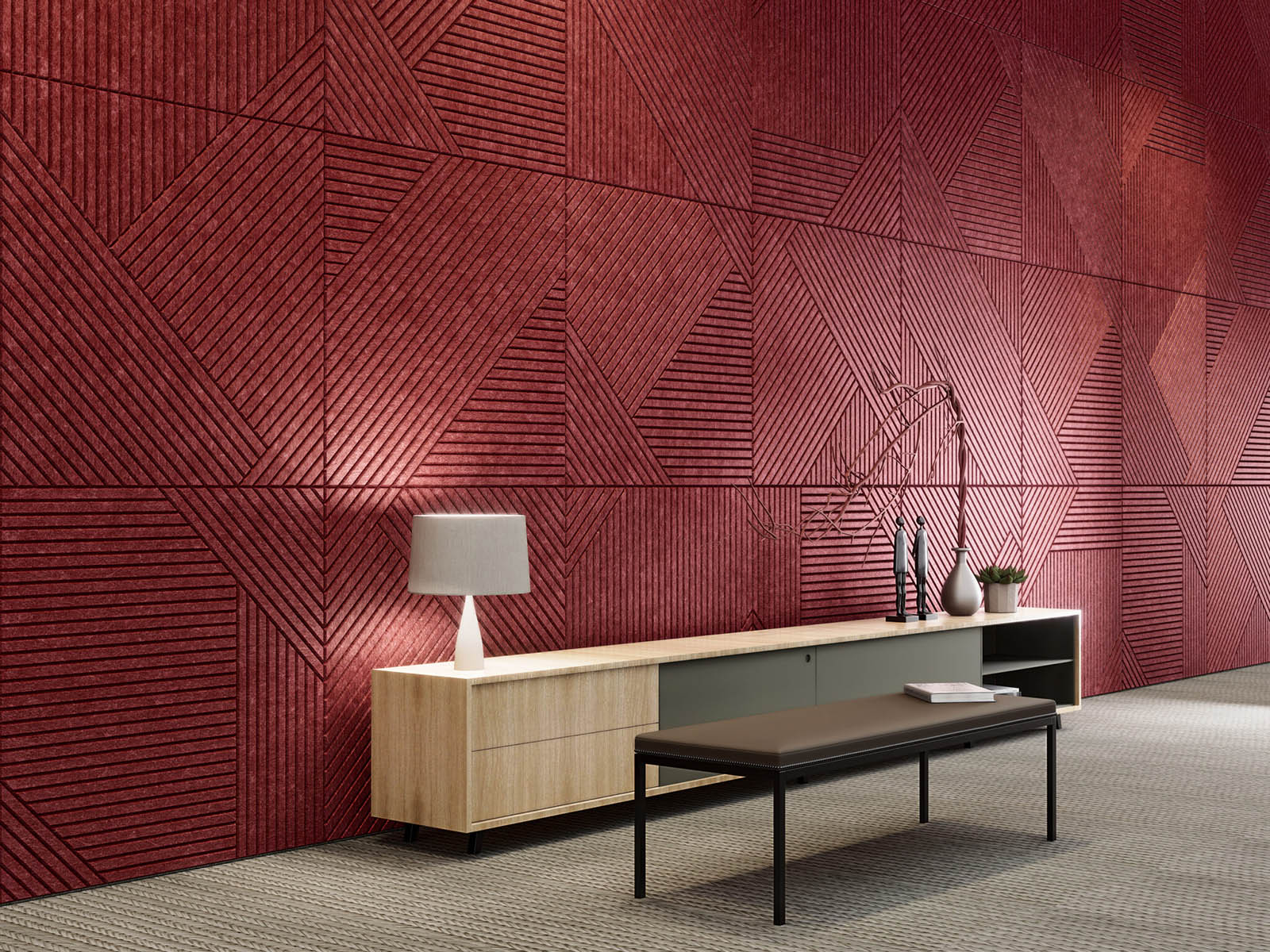
You know how it is after a long day at work, when all you want is a moment of quiet. You walk into a room, a living room or a restaurant and instead of calm, you hear conversations echoing off the walls, the clatter of plates or sounds carrying from a neighbouring room. Sound familiar?
Acoustics is something we tend to notice only when it becomes a problem. Which is exactly why more and more people are paying attention to acoustic comfort – quiet, balanced sound that allows you to genuinely unwind.
One of the most effective and visually striking ways to improve acoustics is with felt sound-absorbing panels.
This understated material, used for centuries, is making a significant return. Felt has become a symbol of quiet, sustainability, contemporary design and the kind of warmth we want in our interiors. So let us look more closely at what felt acoustic panels actually are, how they work and how to choose the right ones for your space.
For the architect, felt is a material that makes it possible to approach acoustics as deliberately as lighting or colour. A few well-placed sound-absorbing panels can transform a space from noisy and disorienting to calm and inviting.
What is a felt sound-absorbing panel?
A felt panel is made from densely compressed polyester fibres and acts as a filter for sound. Depending on the product, it can be made from natural (wool) felt or from recycled PET fibres. That is right, the walls of many modern offices are lined with panels made from plastic bottles given a second life. It is a straightforward and environmentally responsible solution that also improves the quality of the spaces it inhabits.
A high-quality felt sound-absorbing panel is distinguished by the following:
- it absorbs sound across a wide frequency range,
- it does not deform or yellow, even in heavily used spaces,
- it is safe – meeting fire classification standards (e.g. B-s1,d0),
- it is easy to install and maintain,
- it is environmentally responsible – made from recycled materials.
This is why felt panels are increasingly found not only in offices and restaurants, but also in home living rooms, children’s rooms and relaxation spaces. In such interiors, quiet becomes part of the design itself.
How does the felt acoustic panel work?
Anyone who has stepped at least once into an empty apartment or conference room without furniture knows the feeling when echoes bounce off the walls, glass doors and floor. The sound circulates around the room, overlaps with other phalanges and acoustic chaos ensues. It is this effect that even a beautifully decorated interior can be tiring after a few minutes.
A felt acoustic panel acts as a soft barrier to noise. The densely compressed PET fibre material absorbs sound energy rather than reflecting it. Part of the sound wave is captured within the felt structure and converted into imperceptible heat – enough for the sound to lose its force before returning to the listener.
Put simply: felt absorbs excess sound before it has a chance to bounce back. This is why felt panels perform so well in large open-plan offices, where dozens of conversations and devices compete for space. They are equally effective in home living rooms, where a television can fill an entire room, or in children’s rooms, where noise has no natural limits.
Want to learn more about the material itself?
See the article: What is acoustic felt and how does it affect interior sound?
- Acoustic performance
This is, without question, the primary reason for choosing acoustic panels. Correctly positioned elements can significantly reduce reverberation time, and that translates directly into comfort. In a quieter space, we think more clearly, communicate more naturally and recover more quickly.
- Aesthetics and variety of form
Today, an acoustic panel is not a plain slab on a wall, it is a considered design element. The range of colours and cutting methods is virtually unlimited, particularly with technologies such as V-cut, used by Feltdecor. Hexagons, three-dimensional panels, colour compositions, felt slats, the options are extensive. Anyone who has worked on an interior knows how rarely function and appearance align so naturally. Felt panels achieve both: they improve acoustics and enhance the space at the same time.
- Ecology
Many of us are becoming more conscious about our purchases. When you hear that the panels were created from recycled PET bottles, you feel satisfaction. PET felt is an example of environmentally friendly design and proof that you don’t have to sacrifice beauty by using acoustics.
- Easy installation
No specialist is required to install a felt panel. Mounting adhesive or simple suspension systems are sufficient. It is a solution that can transform an interior in a single day.
- Safety and durability
Felt is a flame-retardant, anti-static and UV-resistant material. It does not fade or lose its shape, which means a panel installed today can continue to perform on the same wall for many years.
 Where felt panels are used
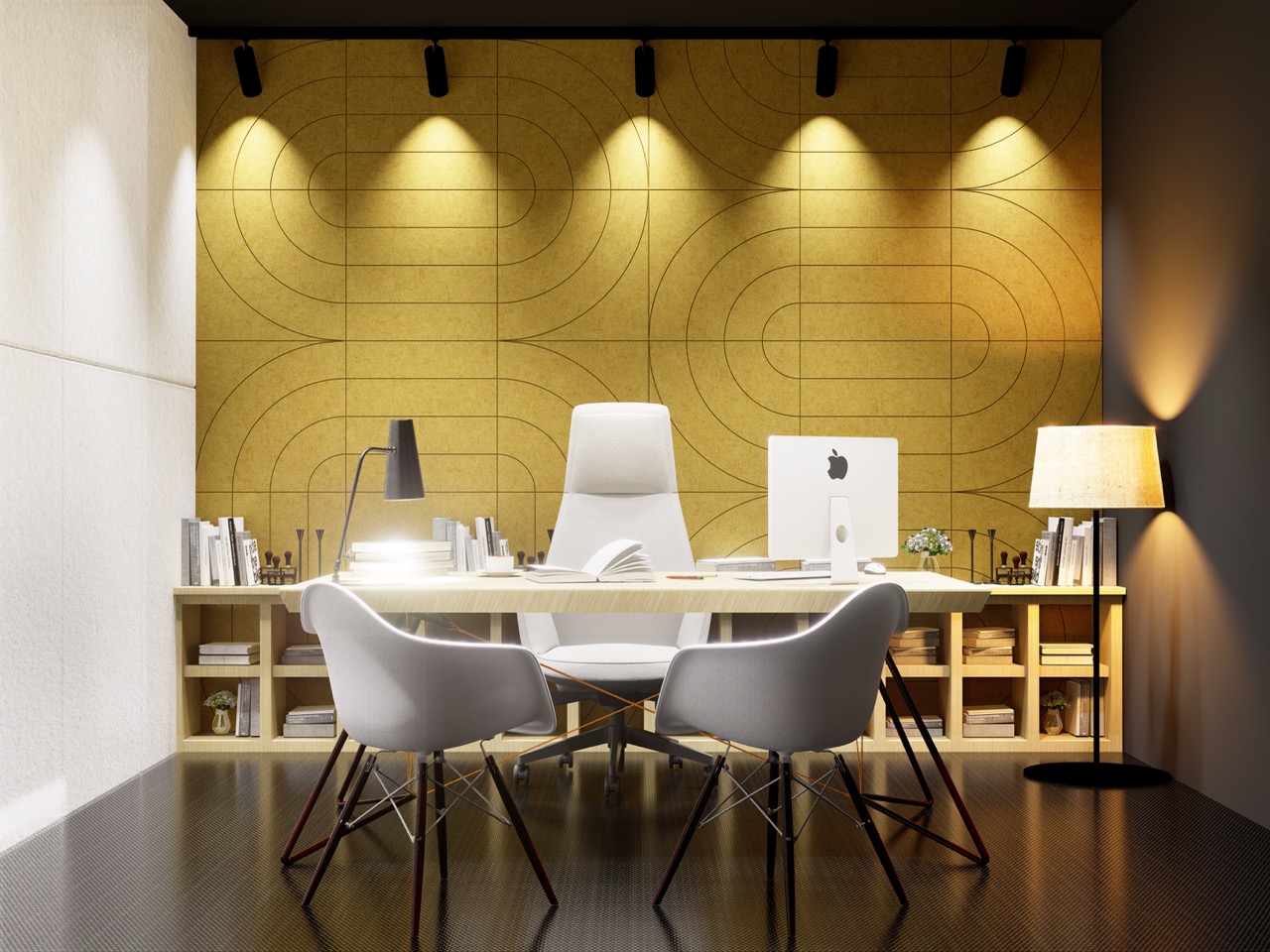
Why is conversation effortless in some cafés or restaurants, while in others it is difficult to follow a single sentence? The answer lies in acoustics. Felt panels eliminate unwanted sound. They perform well in offices, open-plan spaces, restaurants, conference rooms, homes and hotels alike.
Want to know more about the material itself?
See article: What is acoustic felt?
Types of felt acoustic panels
Not all panels are the same, and understanding the differences is useful before making a decision. Below is a brief overview of the main types.
Wall panels
The most versatile option. Mounted directly on the wall, they absorb sound reflections and eliminate echo. They work well in offices, restaurants and homes. Within the TileFlex system, they can be composed into geometric arrangements tailored to any interior.
Ceiling panels
Ideal for high-ceilinged spaces where sound returns from above. Lightweight to install and highly effective, particularly in open-plan offices and lobbies. The SilentScape collection offers these in the form of suspended modules.
Acoustic islands and baffles
Mobile, modular and practical. They divide space without the need for permanent walls, improving acoustics precisely where noise is most disruptive. Well suited to open-plan offices and meeting rooms.
Felt slats
Three-dimensional felt products with a linear form, available with decorative printing of wood or stone textures. A strong choice for representative areas, reception spaces and residential interiors.
See also the article: what is the difference between the thickness of acoustic panels.
 What to look for before buying?
Before placing an order, it is worth pausing to consider a few key factors.
- Acoustic parameters
Not all panels absorb sound equally. Check the sound absorption class (A–E) or the αW coefficient. The higher the value, the more effectively the panel reduces reverberation and improves speech clarity. For a more precise specification, it is worth reviewing the relevant acoustic standards for the type of space in question.
- Panel thickness
A straightforward principle applies: the thicker the panel, the greater the sound attenuation. Thin panels (6-9 mm) are well suited to homes and smaller rooms; thicker options (12-24 mm) are more appropriate for large offices, halls and restaurants. The right thickness depends on the size of the space and the level of noise present – a designer will generally find the right balance between acoustic performance and visual impact.
- Material
Felt can be natural (wool) – soft, luxurious and warm in character – or synthetic (PET) – durable, sustainable and easy to clean. Recycled PET felt is the most widely used today: it combines solid acoustic performance with a responsible approach to materials. It is hypoallergenic, does not attract dust and is more affordable than natural fibre, while the visual result is very similar.
- Color and form
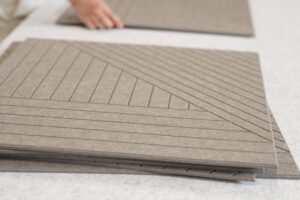
Panels are not only a technology, but also a design element. Pay attention to color, texture and shape, whether you care about geometric patterns, irregular shapes or artistic form. In collections such as TileFlex and TileScratch,you’ll find both minimalist modules and decorative panels. You can adjust them as you like and where you like. You will also combine them with the ceiling in an interesting way, which can really surprise you with form and shape. See an example of our implementation in this style. [here]
- Installation and location
Before purchasing, establish how and where the panels are to be installed. Some are fixed with mounting adhesive; others require a substructure or cable suspension. The mounting method needs to be matched to the surface type (wall, ceiling, glass) and the nature of the space. In an office, ease of removal is typically a priority; in a hotel, long-term durability and fire safety take precedence.
Is it worth choosing felt acoustic panels?
A well-chosen felt panel means genuine noise reduction, durability for years and a timeless look.
Felt on the wall – inspiration and trends
Interior designers are increasingly turning to felt, using it to create entire designs. We have already seen soft industrial-style offices, where grey felt blends perfectly with concrete, and Scandinavian-style salons, where pastel-coloured panels lend the interior a sense of lightness. There’s something for everyone and every style, from geometric hexagons in a child’s bedroom to elegant slats in a hotel reception area.
A felt sound-absorbing panel is more than just a decorative feature. It’s a way to create a space you’ll want to spend time in. Peace and quiet, elegance and sustainability are the three words that best describe this solution. So if you’re wondering whether it’s worth it, the answer is simple. Because a well-chosen felt panel is a long-term investment in quality of life, peace and quiet, and beauty that you can hear… or rather, cannot hear.