Skip to main content
Skip to footer
Skip to main content
Skip to footer

The design of contemporary commercial and residential spaces—fromopen-plan offices to hotel lobbies and intimate premium apartments—places high aesthetic demands on architects. However, the prevalence of minimalist trends, large glass surfaces, and smooth, hard wall surfaces carries a serious design risk: a crisis in acoustic comfort. The use of trendy, thin PET felt cladding—9 mm or 12 mm thick—applied directly to reinforced concrete structures is often an insufficient solution if it is not supported by an in-depth technical analysis of sound waves.
One aspect often overlooked in specifications is the fact that noise is not uniform, and its perceived annoyance depends on its wavelength. Thin PET felt glued directly to the wall is highly effective in the mid- and high-frequency range (from 500 Hz to 4000 Hz), effectively dampening high-pitched sounds and the direct clatter of conversation. However, it is virtually ineffective against low frequencies (125 Hz–250 Hz), such as the bass hum of HVAC systems, the rumbling of appliances, or impact sounds.
At Feltdecor, we believe that an architect’s role is not to choose between flawless design and user comfort. The key to creating the perfect interior is understanding the client and their needs, followed by an understanding of the technical parameters and the thoughtful use ofmulti-layered hybrid systems that combine an aesthetic PET felt outer layer with a technical sound-absorbing core. This article serves as an expert guide that explains how porous absorbers work, interprets key coefficients (αw, NRC, RT60), and shows how to harness the full frequency range using the principles of building physics.
The Mechanics of Porous Absorbers: Why Is Density Alone Not Enough?
To effectively manage interior acoustics, we must stop thinking of acoustic panels as “barriers” or “screens.” PET architectural felt does not reflect sound like MDF or sheet metal—it is a highly porous material. Sound absorption here is based on a process in which sound waves penetrate deep into an open network of microscopic pores and fibers. There, under the influence of air particle movement, viscous losses and thermal losses occur. The kinetic energy of the sound wave is dissipated and converted into thermal energy through the friction of air against the fibrous structure.
When analyzing technical data sheets, designers most often rely on the basis weight parameter, e.g.,9 mm PET with a basis weight of 2000 g/m². This allows them to calculate the apparent density of the material:
2.0 kg/m² ÷ 0.009 m ≈ 222 kg/m³
Although this result indicates the panel’s high density and mechanical stability, the scientific literature (including publications by MDPI and NASA research on porous materials) suggests that basis weight alone does not determine the final sound absorption. A critical parameter isairflow resistivity.
Materials that are too dense or improperly laminated (e.g., with full-surface adhesive or film) lose their permeability and begin to act as a sound-reflecting membrane. In contrast, the PET felt used in systems such as Feltdecor features an optimal fibrous structure. It acts as an advanced front layer, fully permeable to sound waves, which works in conjunction with the technical insulation layers and allows acoustic energy to reach the core of the system.
Material Synergy: How Mineral Wool and an Air Gap Eliminate Low Frequencies
A true revolution in acoustic comfort design occurs when wall cladding is no longer installed in a single layer. To control the full noise spectrum, we use advanced hybrid systems.
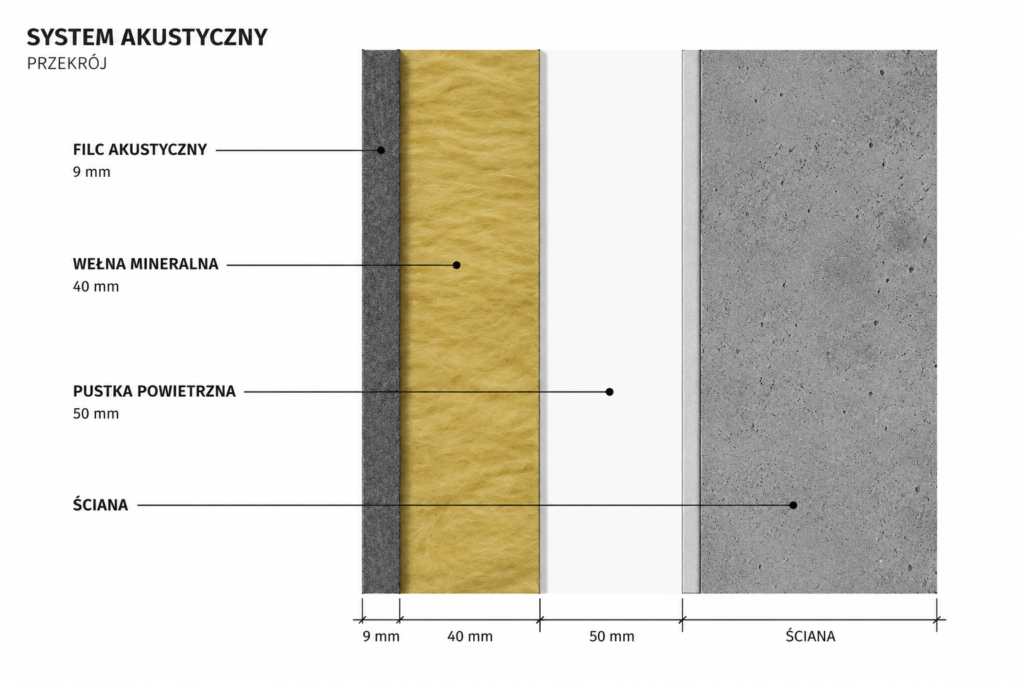
An example of such a solution is the following structural assembly: a panel consisting of 9 mm / 2000 gsm PET felt, 40 mm of industrial mineral wool, and a 50 mm air gap.
From the perspective of building physics and acoustics, this particular material system is based on three closely related phenomena:
- No sound wave blockage: Since PET acoustic felt with a weight of 2000 g/m² exhibits optimal airflow resistance, it does not act as an insulating barrier. It acts as an aesthetic, permeable textile covering through which sound waves pass freely, reaching directly the deeper layer of the absorber—that is, the mineral wool—where they are substantially dampened.
- The Principle of Particle Velocity Amplitude Shift (Air Gap): Near a rigid, hard wall (e.g., a concrete building structure), the acoustic field is characterized by maximum pressure, but the velocity of air particles drops to nearly zero. All porous absorbers—including mineral wool and felt—absorb energy most effectively where the velocity of air particles is highest. Placing the panels away from the wall and using a 50-mm air gap allows the absorptive material to be physically positioned precisely within the zone of maximum wave velocity. This causes the porous structure to operate with greatly increased efficiency.
- The second passage of energy through the porous structure: the portion of acoustic energy that was not fully dissipated during the first pass through the wall panel passes through the air gap, reflects off the rigid building partition, and passes through the porous layer again. This return path allows for additional wave attenuation, which improves the technical performance of the entire system.
Wavelength and the Effectiveness of Wall-Mounted Systems
The need for hybrid systems (PET felt + mineral wool + spacer) becomes clear when we compare the mathematical values of sound wavelengths (calculated using the formula: wavelength = speed of sound divided by frequency, assuming a speed of sound c = 343 m/s):
- Frequency of 1,000 Hz (high-pitched speech, phone ringtones) = wavelength of approximately 34 cm.
- Frequency 250 Hz (male voice, office background) = wavelength approximately 1.37 m.
- Frequency of 125 Hz (rumbling from HVAC and air conditioning systems) = wavelength of approximately 2.74 m.
While high-frequency sounds have a short wavelength and can be absorbed by standard, thin PET felt panels mounted directly against the wall, waves with a wavelength of nearly 3 meters easily pass through thin decorative cladding. Only the use of 40 mm of mineral wool combined with a 50 mm air gap significantly improves the system’s effectiveness, allowing it to effectively absorb low frequencies in the critical 125–500 Hz range.
The alpha-w coefficient and ISO standards: a reliable design specification
The hybrid system described here (9 mm PET / 2000 gsm + 40 mm wool + 50 mm air gap) possesses all the physical characteristics necessary to approach the highest Class A sound absorption rating. As experienced experts, we would like to remind you that the precise, universal sound absorption coefficient (alpha-w) cannot be estimated or copied from unverified sources.
The final result depends on the apparent density and flow resistance of a specific batch of wool, the exact dimensions of the entire panel, and the precision of the installation. For this reason, the market trend described in the literature unequivocally confirms the benefits of using an air gap; however, any advanced design specification should be based on reliable laboratory testing. At Feltdecor, we strive to ensure that our integrated ceiling and wall systems are tested in reverberation chambers in accordance with the stringent ISO 354 and ISO 11654 standards, which provides architects with full legal and technical assurance during building inspections.
Understanding Indicators: How Does Alpha-w (aw) Differ from the NRC Parameter?
In the technical data sheets for sound-absorbing materials, architects most often encounter two abbreviations: alpha-w (aw) and NRC. Although both describe a material’s sound-absorption capacity, they are based on completely different calculation methods. Confusing them in design specifications is a common mistake that can lead to an underestimation of noise problems indoors.
- Alpha-w coefficient (Sound Absorption Coefficient): This is a European standard defined by ISO 11654. It ranges from 0 (total reflection, e.g., smooth concrete) to 1 (total absorption of the sound wave). Importantly, α-w is not a simple mathematical average. It is calculated by comparing laboratory-measured values with a reference curve for frequencies ranging from 250 Hz to 4000 Hz. This standard also allows a material to be assigned a specific sound absorption class (from the highest Class A to Class E).
- NRC (Noise Reduction Coefficient): This is a standard originating in the U.S. market (ASTM C423). It is much simpler—it is the simple arithmetic mean of measurements taken at four frequencies: 250 Hz, 500 Hz, 1000 Hz, and 2000 Hz.
The main pitfall is that the NRC index completely ignores the highest frequency ranges (above 2000 Hz) and, most critically, the lowest frequency range of 125 Hz. A material with a high NRC value may, in fact, be completely ineffective at handling low, bass frequencies. Therefore, for European architects, the alpha-w (aw) parameter, supported by a precise frequency response curve, should be the key indicator of an acoustic system’s quality.
Reverberation time (RT60) – the ultimate goal of acoustic analysis
All project activities—whether they involve selecting the appropriate weight of PET felt or creating hybrid systems with mineral wool—boil down to a single goal: controlling the reverberation time, denoted by the symbol RT60.
Reverberation time is the time (expressed in seconds) it takes for the sound pressure level in a room to drop by 60 decibels after the sound source is suddenly turned off. Simply put, it is the time during which sound “bounces” off the walls and ceiling before it fades away completely.
In a room that is too “lively” (where the RT60 exceeds, for example, 1.5 or 2 seconds), successive syllables spoken by a person overlap. This results in a drastic decrease in speech intelligibility. To make themselves heard, people begin to speak louder, which triggers the so-called Lombard effect and generates increasing background noise (a phenomenon commonly referred to as the “cocktail party effect”).
According to Polish and European building codes (such as PN-B-02151-4), the optimal reverberation time depends on the room’s intended use:
- In conference rooms and classrooms, it should range from 0.4 to 0.6 seconds (the priority is excellent speech intelligibility).
- In open-plan offices, values below 0.6 seconds are desirable to prevent the sound of conversations from spreading to neighboring workstations.
- In hotel hallways and lobbies, values of up to 0.8 seconds are permitted, provided that the space does not amplify the sounds of footsteps or suitcases.
Summary: How to Safely Specify Acoustic Systems?
Effective interior acoustic design requires architects to look beyond the aesthetics of wall surfaces alone. Thin PET felt is a modern and eco-friendly material, but its full technical potential is only realized when the entire cross-section of the structure is thoughtfully designed.
To summarize the most important principles of safe specification:
- Don’t rely solely on the weight or thickness of the felt panel itself—the porous structure and air resistance are key to sound absorption.
- Tackle the full noise spectrum—if there is a problem with low frequencies in the room (HVAC, equipment, bass), design hybrid systems that combine a PET felt outer layer with a mineral wool core and an air gap.
- Request complete data—instead of the simplified NRC index, analyze the alpha-w (aw) parameter along with laboratory test results for individual frequency bands (from 125 Hz to 4000 Hz).