Skip to main content
Skip to footer
Skip to main content
Skip to footer

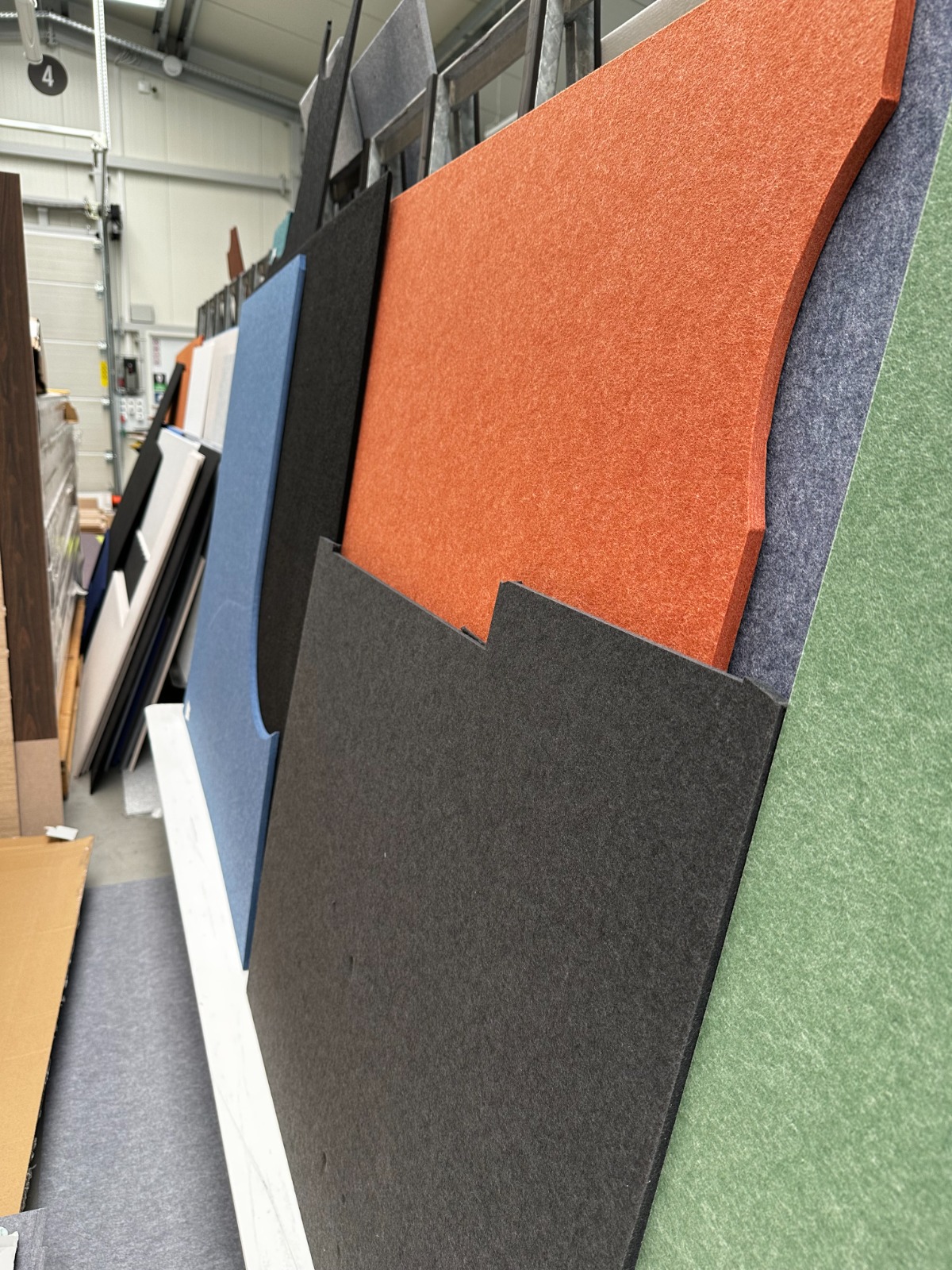
What can you make out of felt? You can use felt to make coasters, wall letters, keychains, a phone stand, and an acoustic panel for above your desk. PET felt used in the production of acoustic panels is 9 or 12 mm thick—several times thicker than sheets from a fabric store, which are typically 1 to 4 mm thick. At this thickness, the material behaves like a thin board rather than a fabric: it holds its shape on its own, stands upright without a frame, and doesn’t fray when cut.
After each batch of panels, we’re left with a pile of scraps. The shapes are irregular, the colors come from the same palette as the finished panels, and there’s so much material that throwing it away in the dumpster simply started to bother us. That’s where our contest came from, but first, let’s talk about the material itself.
At a Glance
- 9- and 12-mm PET felt behaves like a thin sheet, not like fabric. It stands on its own, does not curl, and does not fray when cut.
- The thickness determines what can be made from the material. 1 mm is used for flat patches and decorations, while 9 mm is used for items that are meant to stand on their own.
- PET felt is made from recycled bottles. The scraps left over from our cutting process are plastic that has already been saved from the landfill once—and it would be a shame if it ended up there now.
- Thick pieces can be joined by slotting, just like cardboard advertising stands, without glue or thread.
What’s left after cutting out the panel?
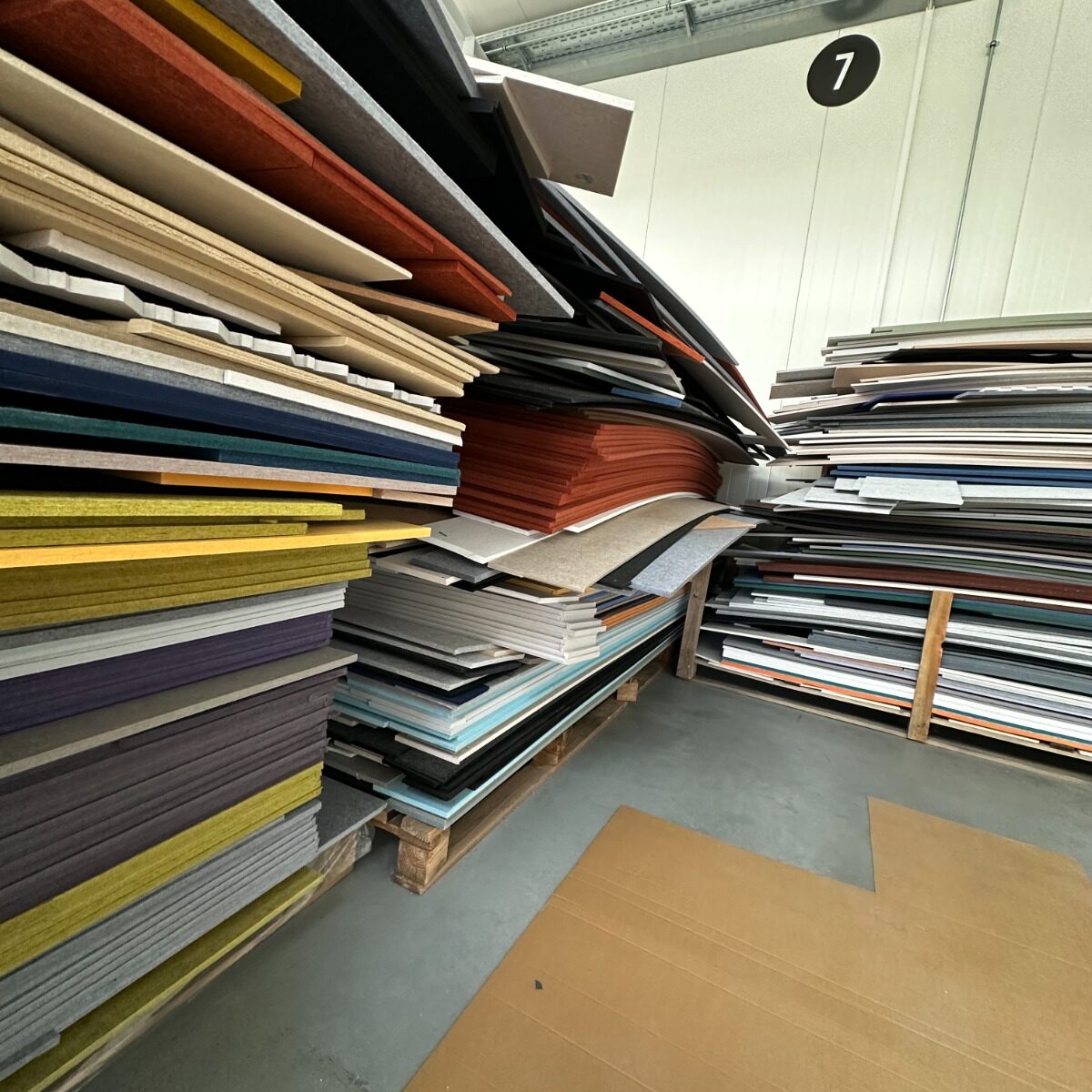
The panel emerges from the sheet as a finished shape, while everything surrounding it remains. Curves where the edges were rounded, wedges between adjacent pieces, narrow strips along the edges of the sheet. These aren’t neatly trimmed rectangles, but shapes that came about by chance, as a byproduct of something else.
The colors are the same as those in the panels, and the palette includes nearly thirty shades, so there are combinations you won’t find at a fabric store.
The thickness of the trim depends on the panel series and is either 9 or 12 mm. This is enough to ensure that even a narrow strip stays rigid and does not roll up.
It’s hard to estimate the size of the offcuts in advance, because it depends on what was being used for production at the time. However, there are sometimes pieces as large as 270 by 50 cm, so the idea doesn’t have to stop at a keychain.
Before you continue, take a look at the photos of the clippings and think for a moment about what you would do with a pile like that.
How do PET felt scraps differ from felt sold at a haberdashery?
The difference lies in the thickness, but it affects everything. Haberdashery felt is a fabric; it can be sewn, pleated, and hemmed. Ours behaves like a thin sheet.
You can’t make a flower, a brooch, or a phone case out of 9 mm felt, because a needle won’t go through that material. Most of the ideas from classic felt craft guides simply won’t work here, and that’s the first thing you should give up on.
Thick felt, on the other hand, can do things that thin felt can’t. It stands on its own, sits far enough back from the wall to cast its own shadow, and stays in place just by the cut itself, without a drop of glue. You have to shift your mindset from sewing to cutting and folding.
You can find out more about the material itself—how it performs in terms of sound absorption and where it works best in interiors—in the article “Acoustic Felt: How It Works and Why You Should Have It in Your Home.”
What can we do with the scraps on our machines?
Since there’s not much you can do here with your hands, the question remains: what can a machine do? The easiest way to demonstrate this is with something that’s already on our desks.
A Felt Kitten: Proof That It Works
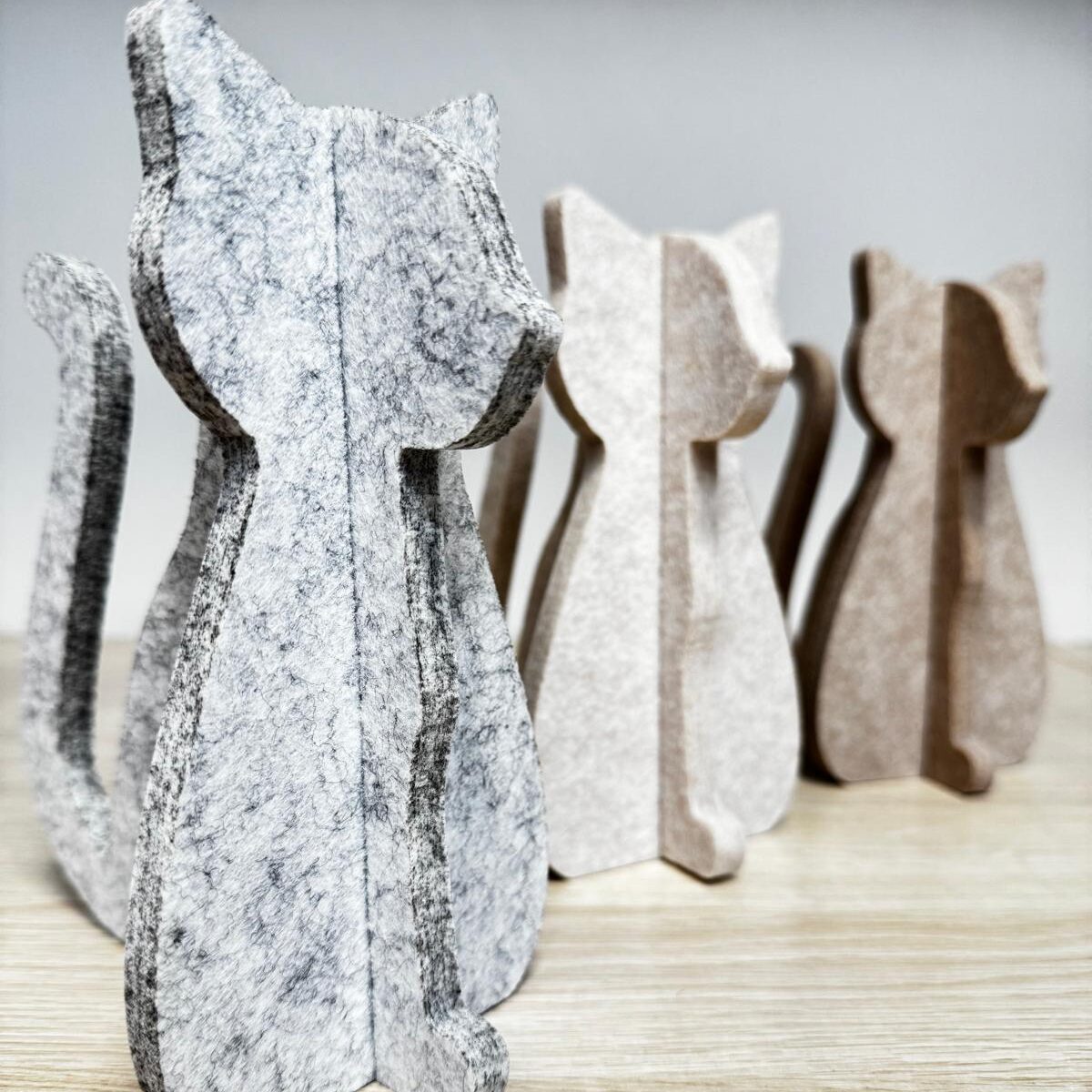
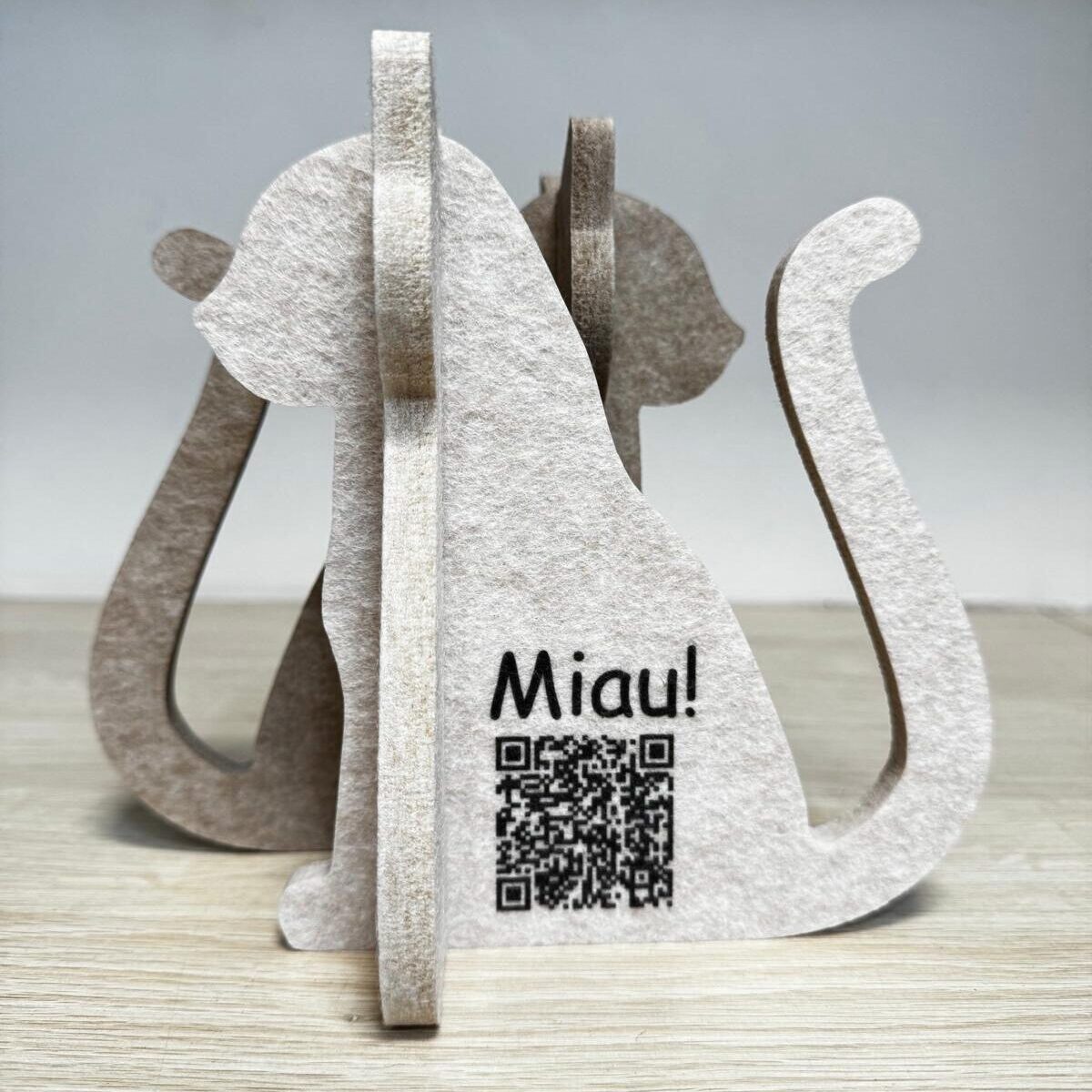
The felt kitten sitting on our desks wasn’t made from a sheet bought specifically for the photoshoot. It was made from a scrap of fabric from the same production run as the panels. Two flat pieces, each with a single slit, slotted together crosswise—and the figure stands on its own. No glue, no thread.
The same principle that applies to a cardboard advertising stand works here because the material is thick. All you need to do is cut slits in the two pieces that are as wide as the thickness of the felt. With a 2-mm sheet, the slit will spread apart and nothing will hold.
You can actually make quite a few things just by joining the pieces along the cut: a phone stand, a mini shelf, letters, figurines.
Cutting out the shape, however, is only half the story. There’s also a QR code on the side of the cat, which means the machine can handle the surface and leave a mark, pattern, or logo on it.
What the machine can do
We machine-cut the shapes on the same production line as the panels. The cut follows a preprogrammed contour and goes all the way through the material, so the cutout emerges in exactly the shape that was previously drawn, complete with the slots for joining.
The cut determines the shape, and everything that’s supposed to appear on the surface is applied by printing. That’s how the QR code on the kitten was created, and logos, text, and patterns are applied to the Tafia felt in the same way.
What the machine won’t do
It won’t stitch or bend. 9- and 12-mm felt cannot be permanently bent, so each item must be assembled from flat pieces rather than formed from a single piece.
“The machine can cut a part as narrow as 1 mm, but when designing, it’s best to assume that the narrowest part is at least 1 cm wide.”
The size of the item, in turn, is limited by the offcuts themselves. An average piece measures about 50 by 50 cm, so it’s safest to plan something that will fit within that. Longer strips do occur, but less frequently.
These aren’t obstacles—they’re guidelines. Anything that can be drawn as a flat shape and assembled without glue, we can cut out.
What Can You Make Out of Felt? Five Ideas to Get You Started
The following five examples illustrate the range: from the simplest thing that can be made from scrap to something that makes use of the material’s intended purpose. Our list of five is just a starting point, and to be honest, we’re hoping someone will come up with something better.
1. Coasters
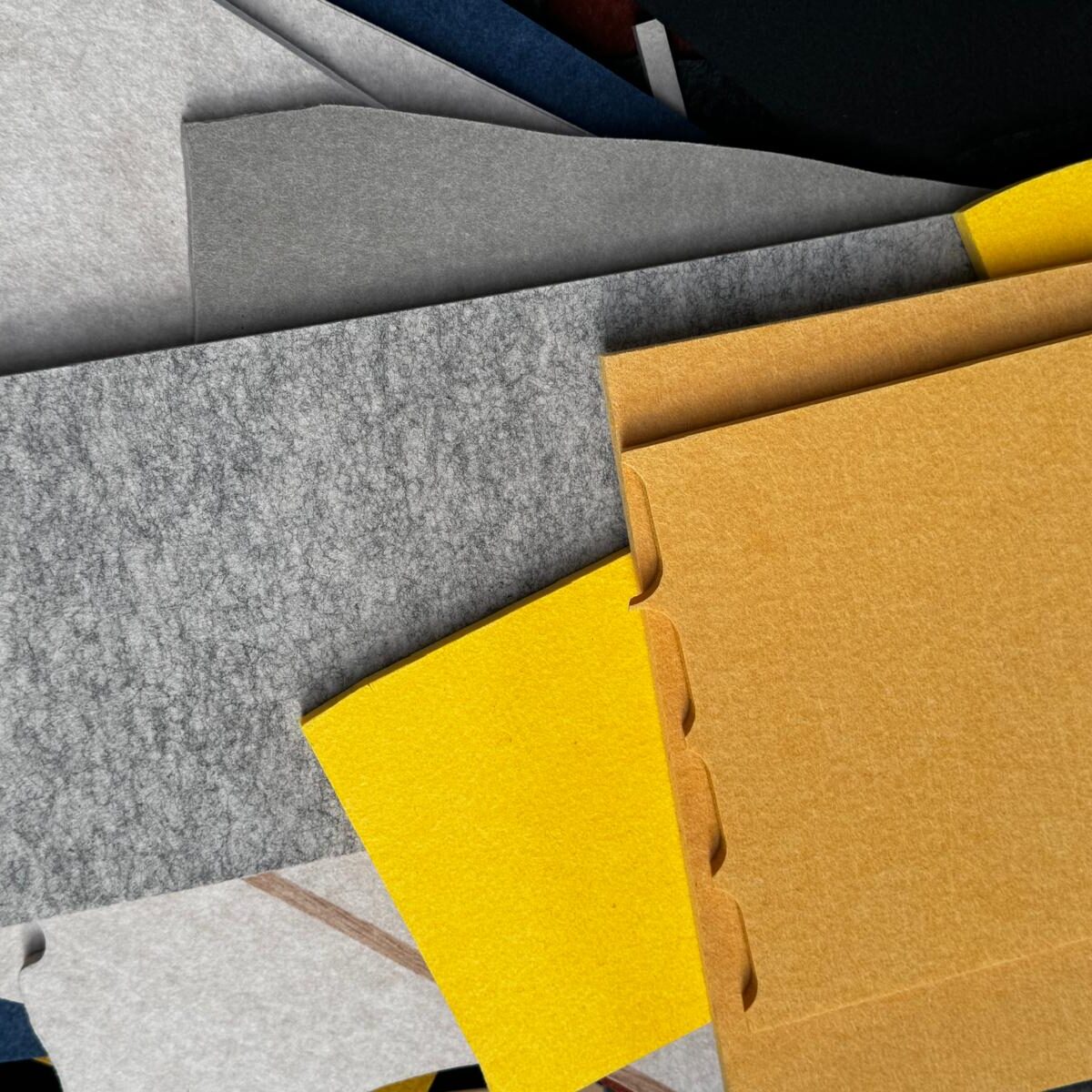
The simplest thing you can make from scrap material—and at the same time, an idea where thickness offers a real advantage. 9-mm felt doesn’t conduct heat, so a hot mug won’t leave a mark on the countertop. Plus, it doesn’t slip like a thin cork coaster.
A set of four different shades from the same series looks better than four identical ones. There’s also room for a logo on this surface, so this exact design works well as a promotional item.
2. Letters and Initials for the Wall
The felt letter holds its shape on its own and does not require any backing. It stands 9 mm away from the wall and casts its own shadow, which is impossible to achieve with thin felt.
There is one limitation: the narrowest part of a letter must be at least 1 cm wide, so typefaces with thin elements are not suitable. If a cut piece is too small for an entire letter, you can assemble it from two pieces that fit together seamlessly, because the edges cut by the machine are even and the seam disappears in the shadow.
3. Keychain
It weighs next to nothing, doesn’t jingle against your keys, and won’t scratch your phone if everything is in the same pocket. It actually wears out in just one spot—where the loop goes in and the fabric rubs against it every time you take it out. Thin felt wears through at that spot, but thick felt holds up.
It’s also the smallest object of the five, so everything takes place within a single shape and a single spot on the mark. This makes it all the more evident what the machine leaves on the surface.
4. Phone stand
Two flat pieces, each with a notch, and the structure stands on its own without glue or screws. It’s the same mechanism that holds the felt cat in place, just in a different form.
Thickness is essential here, not just an extra. The felt has to support the phone without bending under its weight, and if the sheet is too thin, the cut will simply come apart.
5. Acoustic panel above the desk
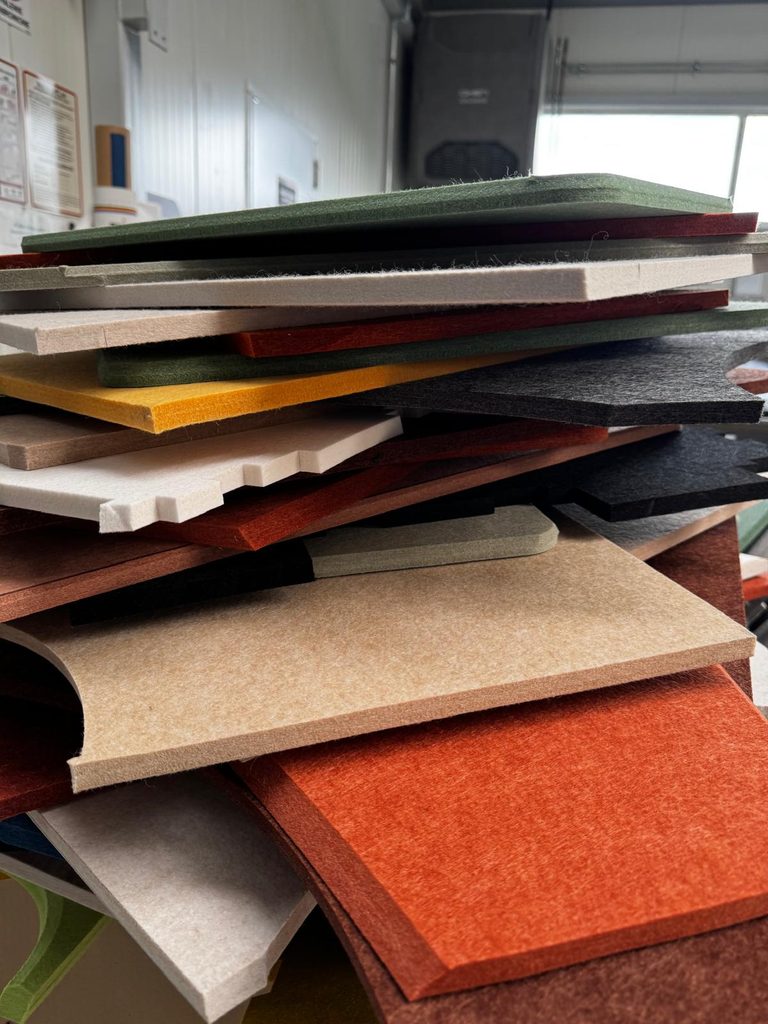
You can use the larger scraps to create a collage for notes, which also helps with sound absorption. The irregular shapes left over from cutting look better on the wall than neat rectangles, because the arrangement looks more lively.
Let’s not kid ourselves—a few pieces of felt won’t soundproof a room. Effective acoustic treatment involves square meters of material strategically placed, not just a few scraps above your desk. A bulletin board made from scraps is a decoration and a place for notes, not a solution to the problem of reverberation.
If you want to make a real improvement in acoustics, it’s easier to use TileFlex modular panels, which are built on the same principle but in a repeatable format.
Felt suggests the shape
The material lends itself well to experimentation, and you don’t have to be a designer to come up with something using it. During our visit to the Academy of Fine Arts in Katowice, design students were using felt to create prototypes of panels, partitions, and lamps inspired by plant structures. It’s a completely different direction than a cat on a desk, but the principle is the same: the material dictates the form, not the other way around.
Is felt eco-friendly?
PET felt is made from recycled plastic bottles, so it is produced from raw material that would otherwise end up in a landfill. The scale is significant: according to Eurostat, in 2021 the EU generated 16.13 million metric tons of plastic packaging waste, and approximately 6.56 million metric tons of that was recycled—less than half. However, PET felt itself is not biodegradable, as it is still a plastic. What makes it eco-friendly is primarily the way it is sourced and the fact that it can be recycled or, as in this article, given an entirely new purpose.
It’s important to distinguish between two concepts that are often confused in this context. Recycling is the process of converting waste into raw material, usually of lower quality than the original. Upcycling is giving an item a new function without breaking it down into its constituent parts, most often resulting in a product of higher value than the original.
A bottle turned into fiber and then into an acoustic panel is recycling. The scraps left over from cutting the panel and turned into a coaster is upcycling. PET felt goes through both of these processes, one after the other
Where can I find scraps of felt?
You’re probably wondering if you can get these leftover items from us. We don’t sell or ship them; they stay in production.
But we have something even better for you. Come up with an idea for what we could do with our leftovers, and if you win, we’ll make it ourselves and send it to you all ready to go. Let me explain 😉
The contest is called “Felt Scraps,” and entering is easy: you sign up on the contest website, receive a link to the form via email, and describe your project in it. It’s the idea that counts, not artistic skills, because we’ll handle the actual crafting anyway. The only requirement is that the object must actually be able to be cut out of the scraps.
And on top of that, there’s a prize that has nothing to do with felt: a free weekend for two in an apartment in Czorsztyn, in the Pieniny Mountains. You get to choose the dates yourself, and the voucher is valid through the end of 2027, so there’s no rush.
We are accepting submissions only through December 1, 2026. Do you already have an idea? Report him here It’ll take you two minutes.