Skip to main content
Skip to footer
Skip to main content
Skip to footer

The “Same Old” Trap and the First-Impression Crisis
The “Same Old” Trap and the First-Impression Crisis
Visualizations in architectural software always look impeccable, captivating the client with their perfect harmony. On the computer screen, large-format wall panels display perfectly even, geometric joints, a deep, uniform matte finish, and an absolutely flawless surface intended to define the luxurious character of a modern office building or apartment. The harsh reality puts these assumptions to the test upon project completion, when strong, linear LED lighting or natural daylight hits the wall. Increasingly, the market is seeing situations where, in theory, the same material—architectural PET felt with a nominal thickness of 9 mm or 12 mm — looks absolutely stunning in one Class A office, yet in another gives the impression of being unfinished, chaotic, and even stained. Why do projects with similar budgets differ so drastically in their visual results? The devil is in the engineering nuances, production culture, and manufacturing rigor—details that distributors of low-cost materials rarely disclose during the bidding process. PET felt is neither a monolithic cast nor a smooth plastic material. It is a technologically advanced composite created through a process of thermal pressing and needling of millions of microscopic polyester fibers. Any oversight during machine calibration, a lack of raw material density control, or—ultimately—the installation crew’s arbitrary decisions on the construction site immediately manifest as visible aesthetic defects. In Feltdecor We know that the architect is accountable to the client for the final visual result, and that the responsibility for any imperfections falls on the architect’s shoulders. That is why, in this article, we take a behind-the-scenes look at the manufacturing process and highlight four key factors that determine whether a PET felt project will meet the required standards premium, or whether it will be grounds for a complaint.
1. Fiber orientation (Fiber Direction) – an invisible trap when held up to the light and optical errors
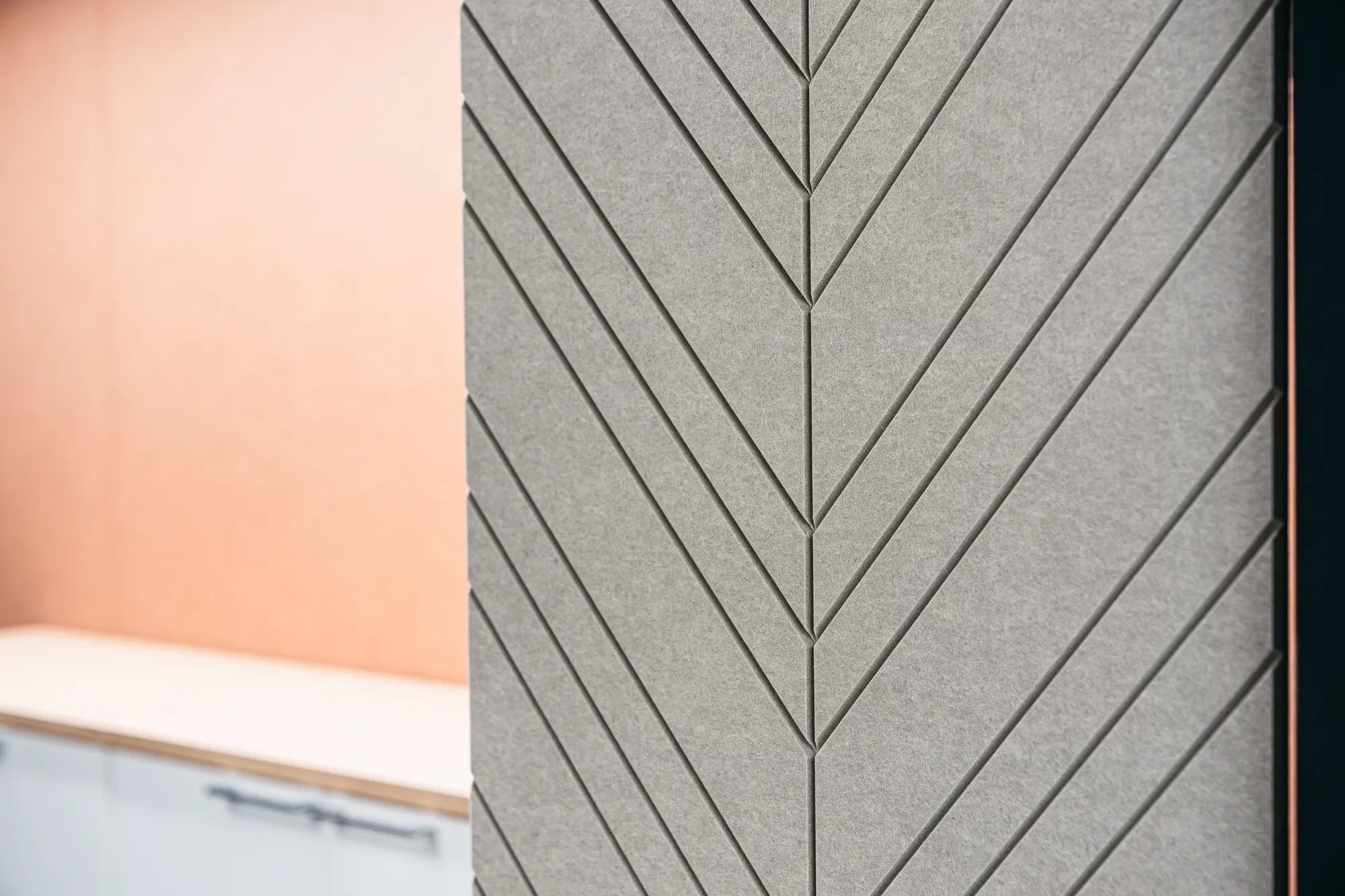
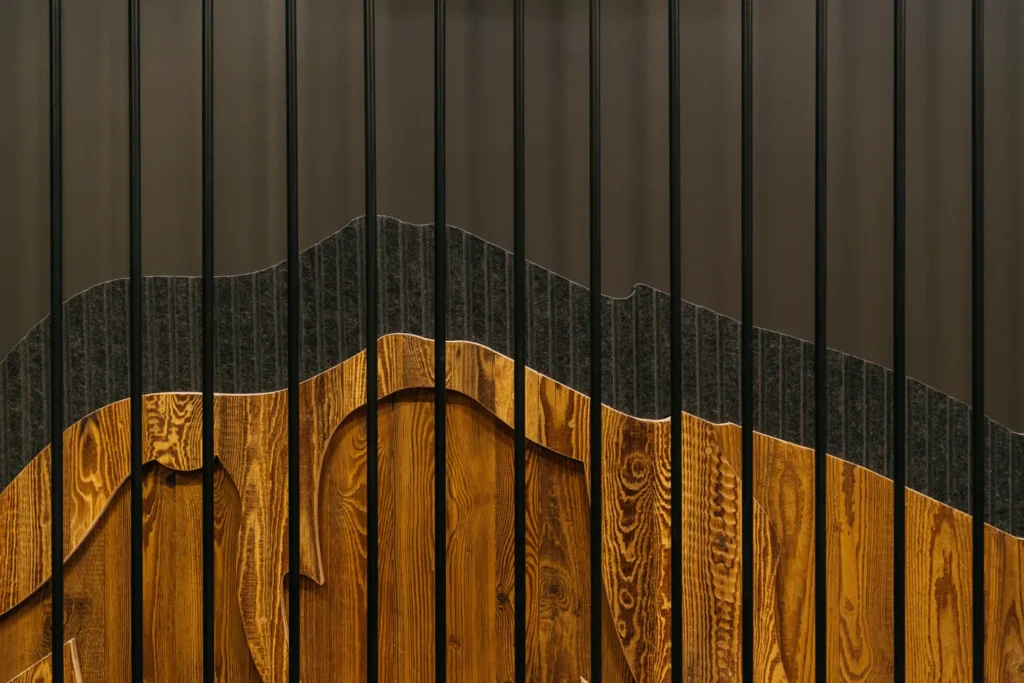
This is one of the most fascinating—and yet most frequently overlooked—aspects of working with architectural felt worldwide, one that can ruin even the most carefully thought-out composition. During the factory needling process, when millions of polyester fibers are mechanically interwoven and then pressed under high pressure at high temperatures, they align in a single, dominant longitudinal direction. Although at first glance the raw, matte PET sheet coming off the production line appears perfectly uniform and devoid of any directional structure, the microscopic alignment of the fibers drastically defines how the finished material absorbs, refracts, and reflects the light falling on it.
The mechanism behind the problem: The real problem arises when the contractor on the construction site receives large-format panels and begins cutting them into smaller pieces on their own—for example, trendy rhombuses, triangles, herringbone patterns, or narrow wall strips. If the installers cut the material randomly, optimizing only the panel’s usage (the so-called nesting irregular) and mount the panels on the wall by rotating some of the elements 90 or 180 degrees relative to each other, the result will be a visual disaster. When exposed to side lighting, daylight, or trendy LED strip lighting, adjacent panels cut from exactly the same sheet will begin to behave like a chameleon. One panel will appear deeply matte and dark, while the other—rotated—will look bright, glossy, and even silvery. To the investor and architect, the wall will look dirty, full of stains and discoloration, even though the physical color of the material is identical. Correct answer – To avoid this problem, it is necessary to rigorously map the positions of the panels on a computer before cutting them on a CNC plotter. All elements that make up a single composition must be cut with the same alignment and grain direction ( Fiber Direction). The material should be delivered to the construction site as a numbered, ready-to-install tile system, complete with precise installation instructions. Once installed on the wall, all the fibers must “face” in exactly the same direction, which guarantees absolute optical uniformity, a velvety depth of color, and a flawless effect from every angle of light.
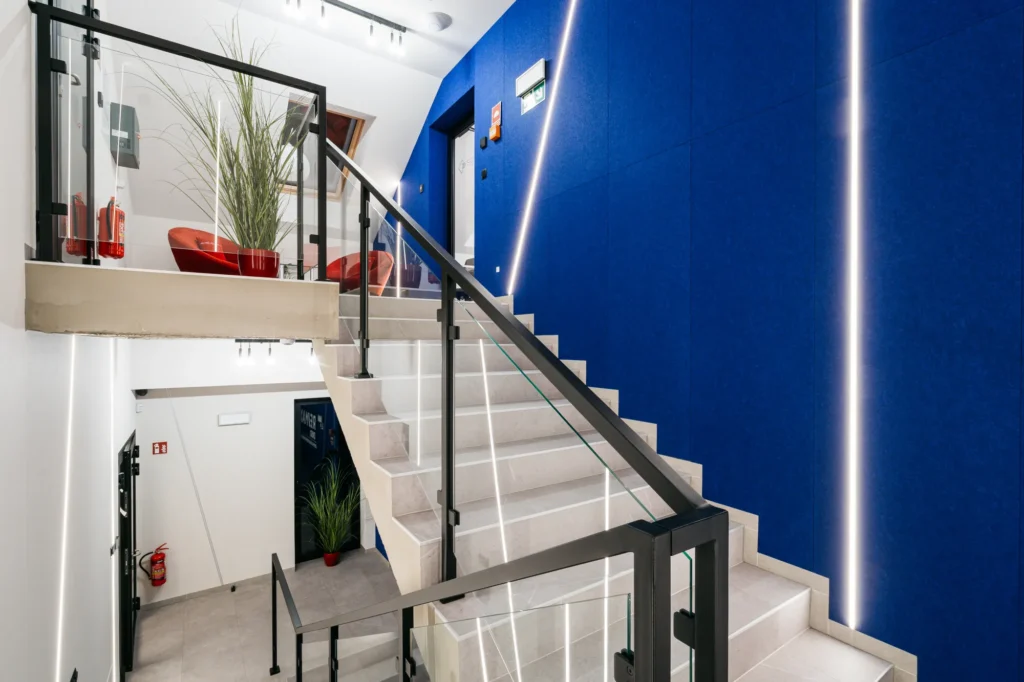
2. Thickness and Density Tolerances – The Quest for Perfect Linearity and the Elimination of the “Stepping” Effect
3. Color batches (Lot Dicing) – why buying panels “in installments” is a recipe for failure
The dyeing process for architectural PET felt is an extremely complex chemical and thermal operation. Polyester fibers are dyed in the mass (in a liquid state, before the filaments themselves are formed), a process that is technologically very similar to those used in the textile industry, wallpaper production, or the firing of large batches of ceramic tiles. Each closed production batch of raw material, referred to in factory terminology as a “lot” (Eng. lot dicing) — has its own unique color characteristics. Even when using advanced computerized pigment dosing systems and spectrophotometers, minimal fluctuations in oven temperature and air humidity, or slight differences in the composition of the batch itself recycled Due to variations in PET pellets, a batch produced in January will differ slightly in saturation, hue, or color temperature from a batch produced in March. Under laboratory conditions, with diffused light, these differences may be nearly imperceptible to the human eye. However, a real aesthetic crisis arises when panels from different production batches are installed side by side on a single wall surface within a building. The most common logistical mistake on construction sites is ordering materials without an adequate safety margin or making last-minute changes to the design. If, during installation, the contractor realizes that a few panels are missing and orders them from a random, current stock at the distributor’s warehouse, the risk of a visible, jarring line appearing in the middle of a prominent wall is nearly 100 percent. Such an error is irreparable and often results in the need to dismantle and dispose of the entire cladding. To avoid this, all material for a given project must be reserved, marked, and cut from a single, precisely validated production batch.
4. Installation errors: construction chemicals that damage the structure from the inside
Even the most technologically advanced product, with ideal geometry and a perfect fiber structure, can be irreparably damaged within a few minutes if the wrong installation technology is used. PET felt, due to its outstanding sound-absorbing properties, is a highly porous material—its interior consists of billions of microscopic air pockets interwoven with polyester threads. However, this acoustic advantage becomes a major challenge during installation if the installation team uses the wrong construction chemicals. The most common mistake made by installers is using contact adhesives that are too thin and aggressive, applied to the panels with traditional paint rollers or brushes, or applying the adhesive too close to the edge of the panel.
The phenomenon of bleed-through (Bleed-through): A thin solvent-based adhesive, driven by capillary action, instantly “migrates” deep into the porous structure of the PET felt. Before the adhesive has a chance to bond with the wall, it passes all the way through the entire thickness of the panel (9 mm or even 12 mm) and appears on the visible, front side of the cladding. The result is permanent, unsightly, darker stains with a greasy or shiny appearance. A panel damaged in this way cannot be cleaned or painted—it is only fit for the trash.
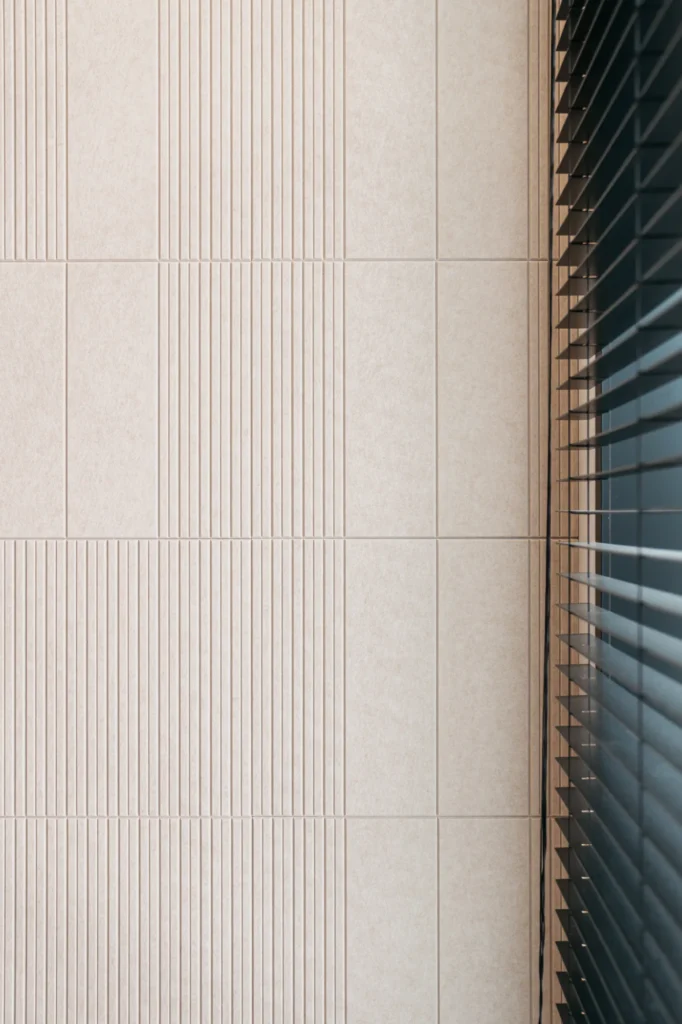
Contamination of grout (Squeeze-out): Conversely, applying too thick a layer of traditional installation adhesive directly at the very edge causes the excess adhesive to be forced out with tremendous force when the panel is pressed against the wall, the excess adhesive is forced out with tremendous force, straight into the perfectly cut gap or onto the precisely beveled V-edgecut. It is technically impossible to remove sticky adhesive from the rough surface of felt without damaging or fuzzing the fibers. Professional systems solve this problem by eliminating liquid adhesives in favor of “dry” technology — panels equipped with a precise, factory-applied self-adhesive layer with high initial adhesion, or dedicated snap-fit and magnetic subframe systems.
A conscious choice of technology is a guarantee of success
Visual luxury in modern commercial and residential interiors is never a matter of chance or luck on the construction site—it is the direct result of rigorous technological discipline. When selecting PET felt acoustic systems, architects should not limit themselves to comparing only the raw price per square meter of material. Key to the project’s success are considerations regarding density stability, panel thickness tolerance, digital control of fiber orientation during cutting, and systematic installation support for contractors. Only full repeatability and a strict production regimen guarantee that the actual final result on-site will 100 percent exceed the expectations created by computer-generated render.