

Find out how to choose effective acoustic panels for your project.
Are you worried the panel will be too thin? That it won’t work? That the client will still hear echo and come back with a complaint?
That fear is understandable. You design an interior—beautiful, cohesive, refined down to the smallest detail. But you also know that acoustics can ruin the entire result. Because what does it matter that the sofa comes from the bestshowroom in Poland—or is even imported from abroad—if the client can’t hear conversations properly due to reverberation and sound reflections? What does it matter that you use the best materials if the space is loud, exhausting, and difficult to use?
In the world of interior design, acoustics is being talked about more and more. But with this awareness comes a question:
Is a 9 mm panel thick enough to effectively quiet an interior?
Wouldn’t it be better to choose something thicker—maybe more “reliable”?
Before you order something “just in case,” see what really determines the effectiveness of panels and how acoustic systems actually work.
Even though it may seem otherwise, sometimes a thin acoustic panel is enough to build impressive silence, without changing the design or risking complaints.
If you still don’t know what acoustic panels are and how they work, take a look [here].
Why does the thickness of acoustic panels raise so many doubts?
Because it’s one of those parameters that seems simple and insignificant… until the moment you have to decide.
In your project—whether it’s an office, hotel, restaurant, or home office—you need to choose something that works. Something that will truly reduce reverberation. The client trusts you, and you can’t afford mistakes. Then the questionappears: 9 mm? Or maybe 12 mm or more? What is the difference at all, apart from the look?! And what if thinner panels turn out to be just decoration—not a real solution?
To make this easier, let’s start with the facts. Thickness does affect a panel’s ability to absorb sound—true. But it is not the only or even the most important parameter. Effectiveness depends on many elements, such as:
- material density and quality – the higher, the better the damping,
- surface structure – e.g., grooves, perforations, ribbing,
- installation – location, layout, the air gap behind the panel,
- total coverage area – most of all.
That’s exactly why panels, even with a small thickness such as 9 mm, can achieve αW = 0.85, which is a high sound absorption class (B). What does that mean in practice? Even with these parameters, you can already feel a real difference—conversations become clearer, echo disappears, and acoustic comfort increases from day one.
Why does acoustic panel thickness matter?
In your project—whether it’s an office, hotel, restaurant, or home office—what matters is not only that you install a sound-absorbing panel, but which panel you choose. Thickness influences how much sound the panel can absorb and in which frequency range. And this directly translates into the acoustic comfort of users.
There is no universal thickness for every interior. The key is to match the panel to the function and characteristics of the space so it can truly work. In smaller rooms, thin and small solutions are enough. In more challenging spaces—high reverberation, hard surfaces, high ceilings—it’s worth considering thicker variants or ceiling modules.
Choosing thickness is a design decision that, when thought through properly, makes a huge difference.
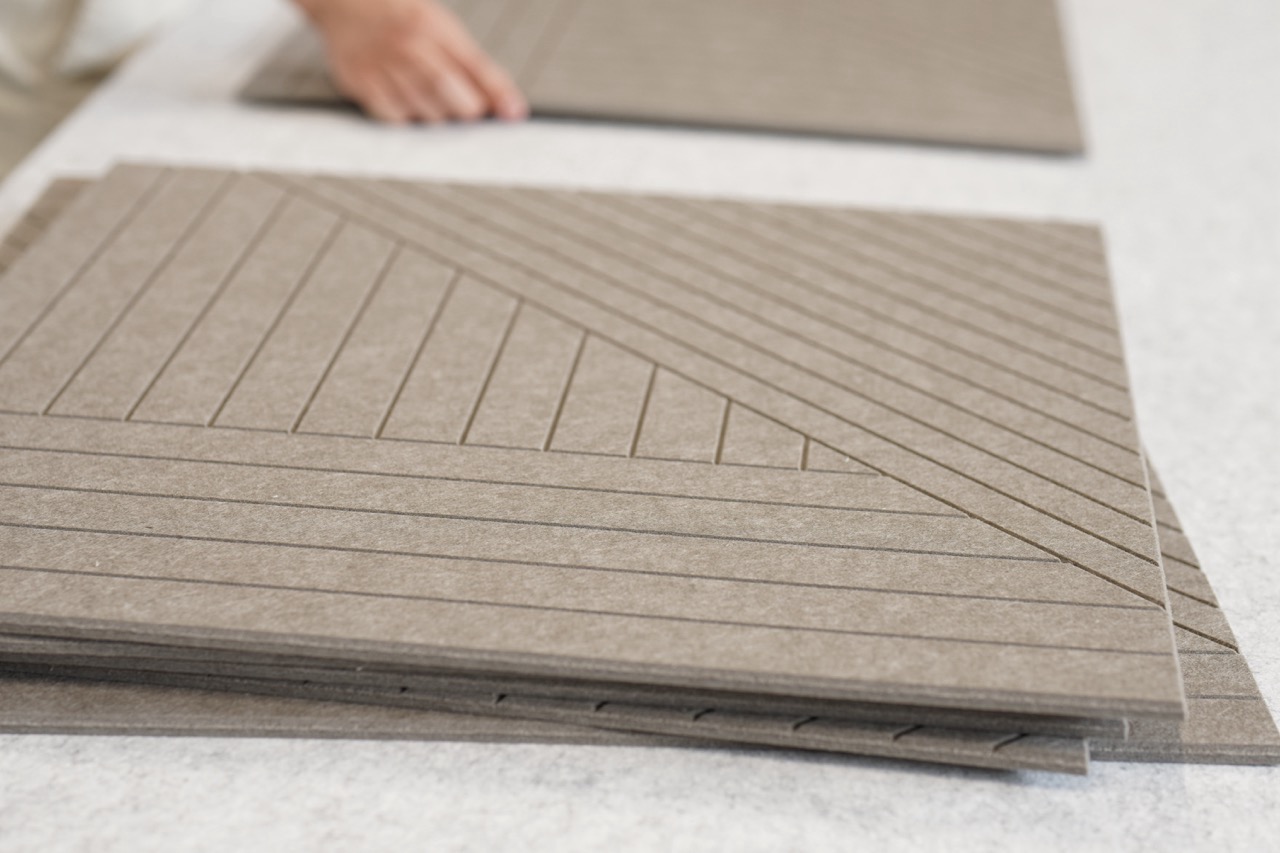
Where do 9 mm panels work best?
Contrary to concerns, 9 mm panels made from high-quality PET felt perform very well in most commercial and residential interiors. Their effectiveness has been confirmed not only by tests, but also by hundreds of projects where the maingoal was reducing reverberation and improving user comfort.
- In open-space offices, wall panels such as TileFlex, combined with ceiling SilentScape, significantly reduce noise. The team can speak freely without raising their voices, and meetings do not disrupt the work of others.
- In a home office, where clear speech during video calls matters, a few PrintSlat panels on the wall can eliminate echo, which can be particularly annoying in small rooms.
- In restaurants or hotel lobbies, where acoustics directly affect comfort and guest reviews, combining wall panels with ceiling islands is enough to create a space where conversation is possible without shouting.
What’s important, 9 mm panels have the advantage of being aesthetic and slim. Unlike thicker options, they don’t interfere as strongly with the interior composition and don’t visually reduce the space. And thanks to a huge palette of coloursand patterns, they can serve both practical and decorative functions.
Is 9 mm a lot or a little? Check what really affects silence in your project.
At first glance, 9 mm may seem like very little. In the world of building materials—where thickness often suggests solidity—it’s just over a centimetre. But in acoustics, this number has a completely different meaning.
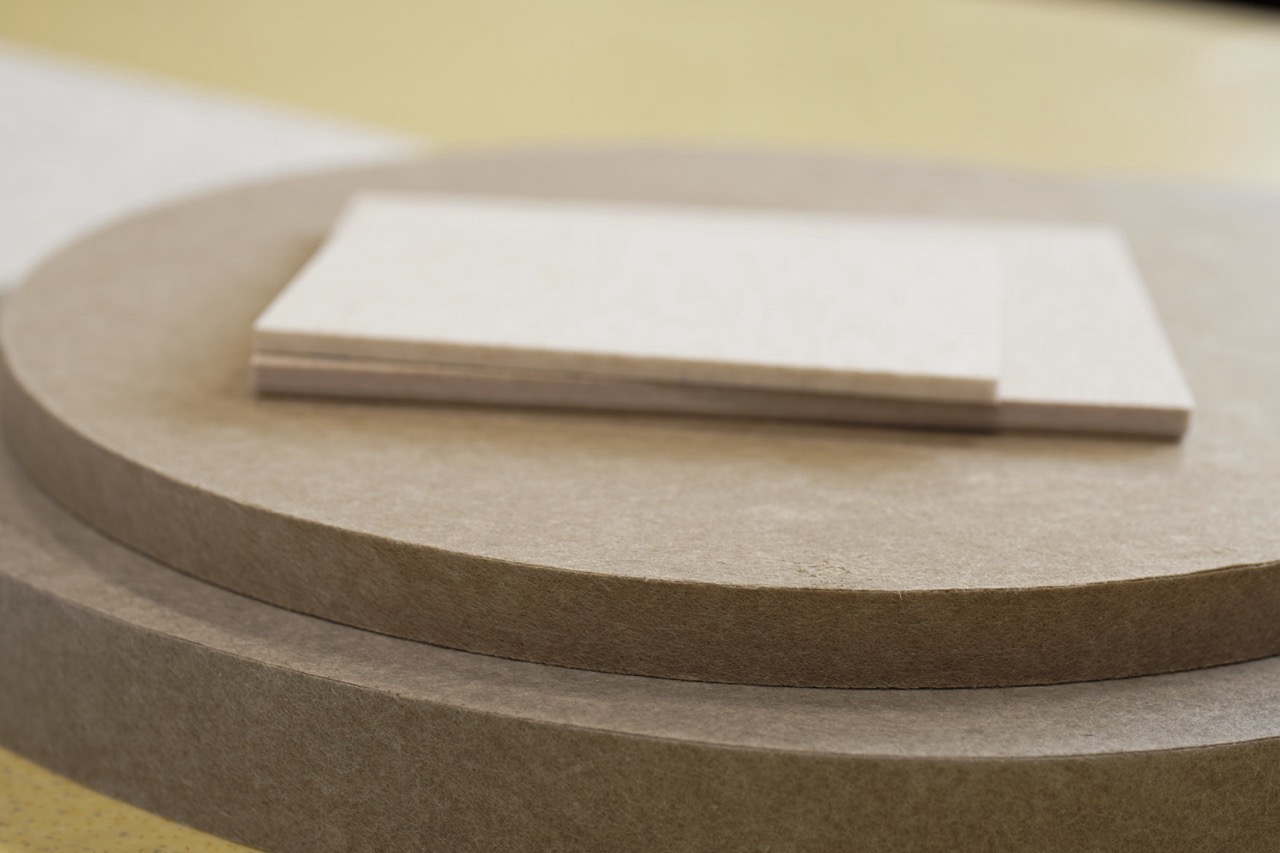
What matters is not only thickness, but what the panel is made of, what density it has, what structure, and also where and how you install it. Acoustic panels, although only 9 mm thick, are made from PET fibre—the porosity and compressedstructure are exactly what make them absorb sound effectively, achieving very good parameters.
What does this mean in practice? That you not only hear unnecessary sounds less, but speech clarity improves, concentration increases, and overall comfort in the space rises.
In projects where balance between design and function is crucial, 9 or 12 mm is a golden mean. They are thin enough not to overwhelm the interior, yet effective enough to truly improve acoustics. It’s not a compromise—it’s a consciouschoice that lets you achieve silence without sacrificing the look of the room.
What about thicker panels: 18 or 24 mm? When is it worth choosing this option?
Sometimes 9 mm may not be enough—not because the panels don’t work, but because the interior sets higher requirements—acoustic or aesthetic. In such cases, panels with thickness from 18 to 24 mm, or even more, can be a good choice—this is a solution we offer for individual projects.
The difference may look small on paper, but 24 mm panels absorb slightly more sound, especially in lower frequencies—the ones that appear in large conference rooms and spaces with concrete, glass, and hard surfaces. Thicker material alsomeans greater mass, and therefore better damping of sound energy.
In practice, 24 mm works best where you want the maximum quieting effect already with a relatively small number of panels. Also if you design a premium space and want the panel to make an even stronger visual impact, and the clientexpects solutions with a higher acoustic standard.
At Feltdecor, we produce thicker panels as part of custom projects—this is a tailored option that allows you to match thickness, colour, finish, and layout exactly to the investor’s needs.
However, remember: thicker panels are heavier, may require a different installation system, and their price and lead time are usually higher. So before you choose them, check whether standard 9 mm or 12 mm won’t solve the problem justas effectively.
If you design a space where acoustics plays a key role and aesthetics must be flawless, a thicker panel can be a great investment. But in the vast majority of cases, it is precisely well-chosen 9 or 12 mm panels from our core collection thatsolve the problem—without needing more.
How to choose the number of panels depending on room size?
This is one of the most frequently asked questions. Let’s assume you have a project—you know the square metres, the wall height, you’ve already chosen the panel pattern… but how many panels do you actually need for the sound control to work?
A simple (but approximate) rule applies: to improve acoustics in a noticeable way, it’s worth covering 25–35% of the wall and/or ceiling area with sound-absorbing material. You don’t have to treat everything—what matters is strategicplacement in the areas where sound reflects most.
In larger spaces, an interesting solution is combining wall panels with ceiling modules, which also creates a spectacular visual effect.
Here are a few examples for acoustic panels with absorption class A or B:
- In a 20 m² room with standard height, it’s worth planning 5 to 7 m² of panels. That equals about 14–20 panels of 60×60 cm.
- In smaller interiors, such as a 10 m² home office, about 4–6 panels are enough, placed behind the desk, above the monitor, or on the ceiling.
- In open office spaces and hotels, think about combining wall and ceiling solutions—for example TileFlex compositions on the wall + SilentScape modules on the ceiling.
The best effects are achieved when panels are placed in first reflection zones—where sound “hits” right after it is produced. That means walls opposite speakers, above workstations (ceilings), partitions between desks, or around meetingzones.
Remember: sometimes it’s better to place 8 panels intelligently than to stick 20 “anywhere.” If in doubt, you can always consult the layout with us—we will help you choose the optimal placement for a specific interior.
A panel with an air gap behind it – even better acoustics without increasing thickness
If you want to further increase the effectiveness of acoustic panels—regardless of their thickness—consider installing them with an air gap behind the panel. This is a very simple technique that involves spacing the panel away from the wallby a few centimetres (most often 3–5 cm, and in demanding interiors even up to 10 cm).
This gap works like an additional absorbing layer—sound waves pass through the panel and are partially trapped, significantly improving absorption, especially at lower frequencies, which are particularly troublesome in commercial interiors.
This provides better sound control without the need for thicker and heavier materials. 9 mm or 12 mm panels with an air gap can perform comparably to 20 or 30 mm panels—or even better—because you gain not only more effectiveabsorption but also better sound diffusion.
All you need is a simple frame or spacers made from wooden or aluminium profiles, which are easy to design and install. If the project allows it—it is definitely worth including.
Summary
Calm and silence are the greatest luxury today—but well-designed, they can become the standard. Panel thickness is only one element of the puzzle. More important is effectiveness, confirmed both by technical parameters and real userexperience.
In offices, restaurants, hotels, and home offices, a 9–12 mm Feltdecor panel is enough to create acoustic comfort that makes a real, noticeable difference—without weighing down the space or sacrificing design. You can also usepersonalised, unique wall or ceiling panels that add extra character to the interior—without the risk of client dissatisfaction.
If you have a more demanding interior, need higher damping, or are looking for something custom—then choose individual options. Thinking about thicker panels? We can prepare them to order.
In [this] article you will find more tips for architects and designers.
(Felt acoustic panels – a guide for architects and designers.)
Do you have doubts and don’t know what to choose?! Write to us!