

You walk into a client’s newly finished apartment.
Wooden floors, large windows, smooth walls, a new sofa, beautiful lighting.
You chat for a moment… and after just a few sentences you feel something is off. Every word bounces off the walls, you can clearly hear the sound “dragging” on, and in the background there’s street noise—or a TV from the other room, children. The client asks directly: “Is it normal that it booms like this? The room is too loud—what can I do if I don’t want to renovate again?”
This is exactly the moment when acoustics stop being theoretical. Echo and reverberation in the living room, bedroom, or home office don’t come from “an expensive interior”—they come from very simple phenomena: reflections off hard surfaces and noisepassing through partitions. As an architect or interior designer, you see the materials—but the client hears the result. And more and more often they’re looking for reverberation solutions without renovation, because they no longer have the budget or energy for tearing up walls.
In this article I’ll show you how to reduce echo in a room without renovation—step by step, from a designer’s perspective. We’ll go through the three main sources of noise at home (reflections from walls, external noise, internal sounds), and then discuss in practical terms:
- which soft materials actually work,
- when regular textiles aren’t enough and PET acoustic panels come into play (including thin, surface-mounted acoustic panels),
- how to use 3D wall décor and felt panels as a design element that also improves acoustics,
- and how to present all of this to a client asking: “Can we do something—without a renovation?”
Step one: understand where the problem comes from
Echo and reverberation appear when sound reflects off hard, empty surfaces: smooth walls, raw floors, bare ceilings, large glass panes. In practice it looks like this: the client moves into a new apartment, built-ins are finished, but the living room has only a sofa and a coffee table—resulting in a too-loud room where every word “travels” through the entire interior. The natural question is: “What do I do?” And that’s where reverberation solutions without renovation start—everything that helps you reduce echo without renovation, from ordinary textiles to more deliberate use of acoustic panels and wall décor.
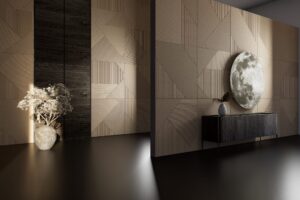
3 main sources of noise at home (and the questions you’ll hear from clients)
Before you look for reverberation solutions without renovation, name the three main sources of the problem. This makes it easier to choose the right actions—and helps the client understand why their interior is so loud.
1) Sound reflections from hard surfaces — classic echo and reverberation
This is the most common scenario. When you have:
- smooth painted walls,
- hard flooring (tiles, laminate, resin),
- a bare ceiling,
- large windows with no curtains,
sound bounces between surfaces like a ball. That’s when you hear: “This room is too loud—what can I do?”
This is where textiles, PET acoustic panels, thin wall/ceiling panels, and even clever 3D wall décor (that isn’t “just decoration”) come into play.
In these interiors you’re usually solving how to reduce echo without renovation—and it’s absolutely doable if you plan sufficiently large “soft” surfaces.
2) Noise from outside — street, neighbours, the city
The second group of problems is sound that enters the apartment:
- traffic,
- a tram outside the window,
- a playground,
- neighbours from the staircase or upstairs.
The client still experiences “noise,” but the solutions differ from treating reverberation alone. If there’s no budget for replacing windows or insulating walls, you can:
- strengthen the interior-side barrier (curtains, bookcases, built-ins),
- plus targeted PET acoustic panels on walls bordering the noisy zone.
These are still no-renovation acoustic solutions, but more focused on reducing what comes from outside.
3) Noise generated inside the apartment
The third type is everything happening inside:
- conversations in the living room,
- louder movies,
- gaming,
- appliances, music, home audio equipment.
In apartments with thin walls, these sounds “travel” between rooms. Here you often get questions about reducing echo without renovation and also soundproofing a wall facing neighbours or a corridor. This is a natural area to propose:
- thinner panels,
- PET wall acoustic panels,
- or lighter 3D wall décor that combines aesthetics and function.
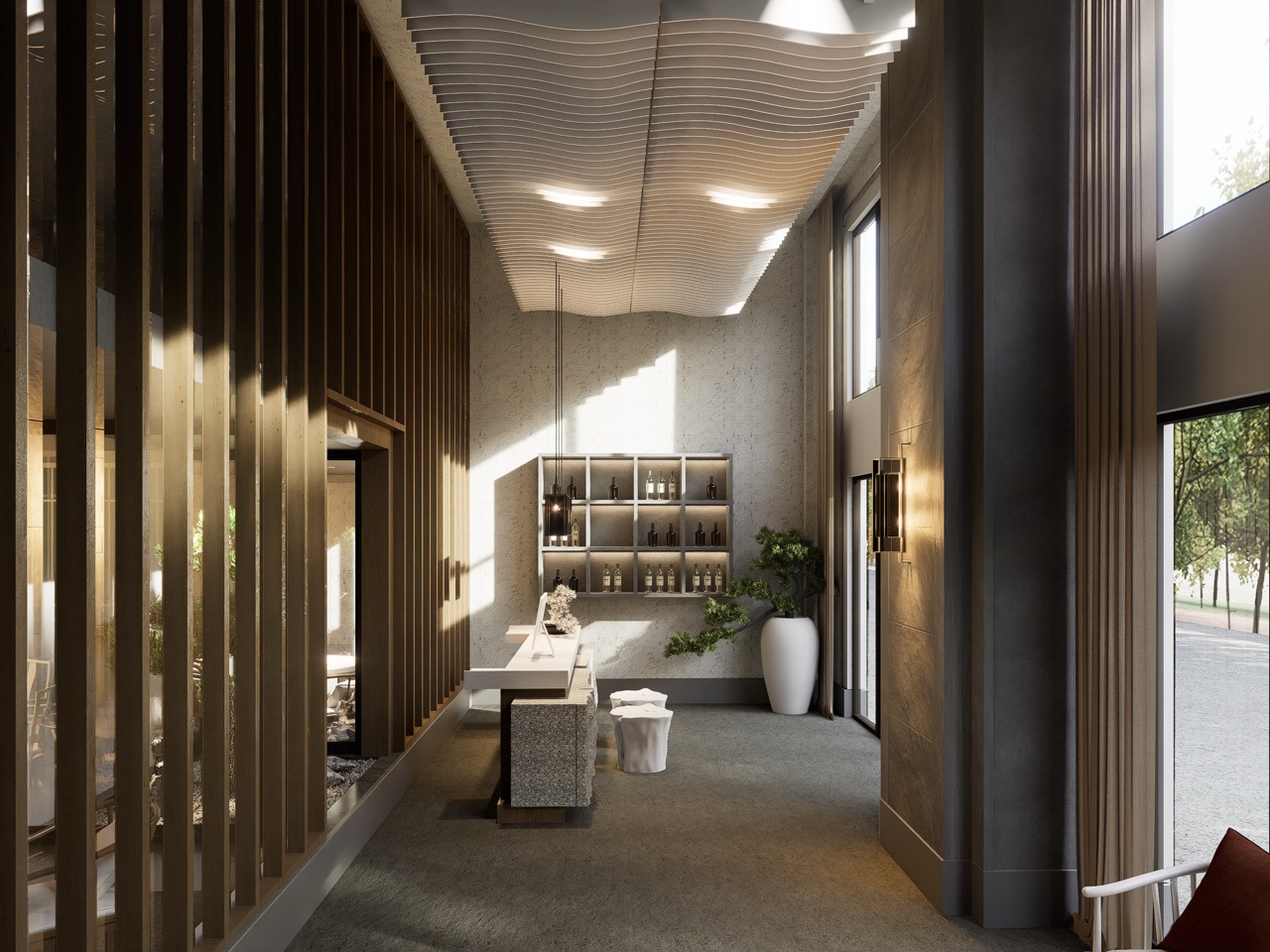
Three solution categories — when another renovation isn’t an option
Clients usually say: “The floors are done, the built-ins are finished, everything’s painted. I need something quick and without renovation. What exactly should I do?”
Here are three levels of actions you can recommend—from simplest to more advanced.
1) Textiles and soft materials — quick first aid
The simplest answer to: “How do I reduce echo without renovation?”
You can use: 
- a large rug instead of raw flooring,
- heavier curtains instead of only roller blinds,
- more upholstered seating,
- fabric on walls (throws, kilims, soft wall elements).
These aren’t specialist acoustic treatments, but they genuinely shorten reverberation. For many clients, this is a good first step before moving into PET acoustic panels.
But be clear: if the problem is serious, textiles alone may not be enough—especially when a too-loud room is caused by large floor area and high ceilings.
2) Acoustic panels — when you need more than a rug
If you want more control over acoustics, PET acoustic panels come in.
Why PET felt?
- lightweight, fire-rated, easy to clean,
- easy to install (can be glued to walls or ceilings),
- no structural interference required,
- can be treated as 3D wall décor.
In homes and apartments, thin acoustic panels—glued directly to the wall without a frame and without reducing usable space—work extremely well.
Practical scenarios you can offer the client:
- Living room — one larger feature wall built from panels (e.g., based on the TileFlex system): decoration + function in one.
- Home office / acoustic panel for home office — panels behind the desk or opposite it to eliminate echo during online calls.
- Children’s room — colourful 3D wall décor that looks like a graphic but works like acoustic panels.
If you want to dive deeper into panel placement, see our article:
“Where is the best place to install acoustic panels?”
Here you can also learn more about TileFlex wall panels (link).
3) Smart furniture placement and “sound obstacles”
This sits between “do nothing” and “install a full panel system.” You can:
- place a large bookcase on the wall that reflects sound the most,
- use tall plants as natural diffusers,
- add artworks with thin acoustic panels behind them,
- break long empty walls into segments: some furniture, some PET acoustic panels, some textiles.
This is also where 3D wall décor can be introduced to break up an “empty corridor” effect or a bare living room wall.
These are still no-renovation acoustic solutions—you’re working with layout and lightweight elements, not tearing into partitions.
How to present it to the client — three simple answers to one question
When a client says: “My room is too loud—what can I do, but without a major renovation?” you can structure your answer in three steps:
- Diagnosis
- Is the main problem echo and reverberation?
- Is external noise the bigger issue?
- Or is it a mix of both?
- Action levels
- Textiles + furniture layout (minimum).
- PET acoustic panels and thin acoustic panels where echo is strongest.
- 3D wall décor where the wall is “asking” for a stronger visual effect.
- A concrete example
- “Here we’ll create a FeltDecor panel composition, here we’ll add curtains, and this wall will become the home-office acoustic panel zone.”
That way, the client gets a clear plan for how to reduce echo without renovation, instead of a vague “well… you could hang something.”
Where does FeltDecor fit into this?
As a designer, you can treat FeltDecor solutions as a toolkit:
- TileFlex — modular PET acoustic panels that can be arranged as 3D wall décor in a living room or home office.
- AbstractTile / other decorative collections — when you want to combine graphics with acoustics.
- SilentScape (for single-family homes) — when the issue is large volume and you need a lightweight, suspended acoustic ceiling.
In every case you tell the client something simple:
“These are no-renovation reverberation solutions—glue-on, hang-on, surface-mounted. No demolition, no mess, and the too-loud room finally becomes a place you can actually live in.”
Imagine that same living room, office, or bedroom you’re discussing with the client during the design stage—only now, after a few thoughtful changes. The rug stops being “just décor,” curtains do more than block light, and wall panels are no longer randomgraphics—they become a deliberate tool that calms the space. Suddenly, dinner-table conversations don’t bounce off the walls, a home call doesn’t sound like a staircase, and evenings simply feel quieter.
That’s the difference between an interior designed “for photos” and one designed for real life. As a designer, you can influence how a home will sound—even when the client clearly says the renovation is already done. Well-chosen textiles, smart furniturelayout, PET acoustic panels, or decorative thin wall panels can do more than yet another set of cushions.